
For enterprise technology leaders, quantitative hedge funds, healthcare providers, and high-growth SaaS platforms, 2026 has marked an irreversible paradigm shift in artificial intelligence: the transition from stateless, single-turn completion models to autonomous, multi-step **frontier reasoning models**. While proprietary reasoning endpoints such as OpenAI o1/o3 and Anthropic Claude 3.7 Sonnet deliver remarkable mathematical and algorithmic problem-solving capabilities, their integration into mission-critical production workflows has exposed two crippling operational bottlenecks: exorbitant, non-linear API cost inflation and severe regulatory compliance vulnerabilities.
At Beyond Ambition, our AI Engineering & Model Integration Practice and DevOps & Cloud Infrastructure Specialists design high-concurrency inference backends for demanding enterprise environments. Across algorithmic fintech networks like Atmos Funded, high-throughput trade order routers like Funded Trader Markets, and autonomous workflow automation engines like IonicX AI, we routinely audit enterprise AI deployments where monthly third-party LLM inference invoices surge past $60,000 to $100,000. Crucially, sending proprietary trading algorithms, unredacted patient medical records, or sensitive intellectual property across third-party SaaS boundaries fundamentally violates SOC2 Type II, HIPAA, and GDPR compliance mandates.
The open-weights release of DeepSeek-R1 has shattered this proprietary monopoly. By combining pure large-scale Reinforcement Learning (RL) with Multi-Head Latent Attention (MLA) and DeepSeekMoE architectures, DeepSeek-R1 achieves benchmark parity with OpenAI o1 on MATH-500 (97.3%) and AIME 2024 (79.8%) while offering open weights under an MIT license. In this comprehensive production playbook, we dissect the memory thermodynamics of hosting 671 billion parameters, engineer a distributed multi-node vLLM v0.7+ cluster on Kubernetes with KubeRay, construct an asynchronous zero-trust streaming proxy to sanitize internal `<think>` reasoning traces, evaluate real-world TCO economics, and provide a battle-tested blueprint that cuts enterprise reasoning OpEx by more than 70%.
1. The Proprietary API Trap: Why Enterprise Reasoning Belongs On-Premises
To evaluate why proprietary reasoning APIs create unsustainable financial pressure, one must understand how test-time compute scaling fundamentally alters token generation economics. In conventional LLM architectures (such as GPT-4o or Llama 3.3 70B), the ratio of input prompt tokens to output generation tokens is roughly balanced or heavily tilted toward input prompts. However, frontier reasoning models rely on extended Chain-of-Thought (CoT) reasoning loops: before returning a single character of actionable response, the model generates thousands of intermediate reasoning tokens—deliberating over edge cases, backtracking through failed hypotheses, and self-correcting logic.
On proprietary cloud platforms like OpenAI, these intermediate thinking tokens are billed at the full output rate—often $60.00 per million output tokens for top-tier reasoning tiers. When an enterprise platform processes 25,000 complex reasoning queries daily (such as automated legal contract verification, financial risk modeling, or multi-agent code refactoring), the hidden CoT token volume pushes monthly cloud API spend past $75,000. Compounding the financial burden, multi-tenant public APIs frequently suffer from unpredictable p99 latency spikes during peak commercial hours, triggering client-side timeouts in real-time applications.
Even more pressing than cost is the data privacy dilemma. Regulated industries cannot tolerate the risk of proprietary prompt data being stored in external vendor logs, accessed by third-party human annotators, or subject to subpoena in external jurisdictions. Self-hosting DeepSeek-R1 inside a private, air-gapped Virtual Private Cloud (VPC) on AWS, Google Cloud, or on-premises bare-metal GPU clusters guarantees 100% data sovereignty. Prompt inputs, intermediate reasoning traces, and final completions never traverse public internet conduits, satisfying even the most stringent zero-trust security postures.
2. Sizing the Compute Fabric: VRAM Economics, FP8 Scaling & Multi-Head Latent Attention
Hosting the full DeepSeek-R1 model requires navigating the hardware realities of a 671-billion parameter Mixture-of-Experts (MoE) network. Structurally, DeepSeek-R1 is composed of 61 transformer layers featuring 1 shared expert and 128 routed experts, with 8 routed experts activated per token. This translates to approximately 37 billion actively executing parameters per forward pass, delivering the computational throughput of a mid-sized dense model alongside the world-class reasoning capacity of a 600B+ giant.
In standard 16-bit floating point (BF16), storing 671 billion parameters requires roughly 1.34 terabytes of raw GPU memory purely for model weights—demanding an unwieldy cluster of at least 24 to 32 80GB GPUs before factoring in context memory. The practical breakthrough for production deployment is **FP8 Quantization (E4M3 format)**. DeepSeek-R1 was natively trained with mixed-precision FP8 kernels, meaning that running official FP8 checkpoint weights (`deepseek-ai/DeepSeek-R1` FP8) reduces the static weight footprint to approximately **641 gigabytes** with mathematically undetectable loss in reasoning benchmark precision:
$$VRAM_{weights} = 671 \times 10^9 \text{ parameters} \times 1 \text{ byte (FP8)} \approx 625 \text{ GiB} \quad (641 \text{ GB})$$
Equally vital is DeepSeek-R1's novel **Multi-Head Latent Attention (MLA)** mechanism. In conventional Multi-Head Attention (MHA) or Grouped-Query Attention (GQA), the Key-Value (KV) cache scales linearly with sequence length, model dimensions, and head count, consuming hundreds of gigabytes of VRAM during extended 32K–64K token reasoning sessions. MLA fundamentally resolves this by projecting the Key and Value vectors into a low-dimensional compressed latent space ($d_c = 512$):
$$VRAM_{KV\text{ (MLA)}} = 2 \times N_{layers} \times d_c \times L_{context} \times \text{Precision}_{bytes}$$
Because $d_c$ is a fraction of standard multi-head dimensions, MLA slashes KV cache memory consumption by **85% to 90%** compared to standard MHA. Under vLLM, a single concurrent 32K context stream requires only ~0.15 GB of KV cache VRAM instead of 1.2 GB. This thermodynamic efficiency enables an enterprise cluster of **16× NVIDIA H100 80GB SXM5 GPUs** (configured across two 8-GPU nodes) to comfortably hold the 641 GB FP8 model weights while reserving over 600 GB of aggregate VRAM for high-concurrency KV cache paging.
3. Distributed Cluster Topology: KubeRay on EKS, Tensor Parallelism & InfiniBand RDMA
Serving a 641 GB model across 16 GPUs requires a hybrid parallelism strategy that balances inter-GPU memory bandwidth against inter-node network latency. Under vLLM, the optimal distributed serving architecture combines **Tensor Parallelism (TP=8)** within each physical server chassis with **Pipeline Parallelism (PP=2)** across nodes:
- **Tensor Parallelism (TP=8) Intra-Node:** Within each 8-GPU server (such as an AWS `p5.48xlarge` instance), all 8 NVIDIA H100 GPUs communicate via the fourth-generation NVLink switch fabric at an astounding 900 GB/s bidirectional bandwidth. Transformer layers are partitioned across all 8 GPUs, performing zero-latency all-reduce operations for attention and MoE feed-forward projections.
- **Pipeline Parallelism (PP=2) Inter-Node:** The 61 transformer layers are divided sequentially across the two 8-GPU nodes. Node 1 executes Layers 0 through 30 (Pipeline Stage 0), while Node 2 executes Layers 31 through 61 (Pipeline Stage 1). Communication between nodes is restricted to passing activation tensors between stages at the boundary.
- **InfiniBand Interconnect Fabric:** To prevent inter-node pipeline bubbles, the cluster nodes must be networked via a minimum of 3.2 Tbps NVIDIA Quantum-2 InfiniBand (or AWS Elastic Fabric Adapter / EFA) utilizing Remote Direct Memory Access (RDMA) and NVIDIA NCCL ring buffer primitives.
- **PagedAttention v2 & Chunked Prefill:** vLLM's PagedAttention allocator partitions the KV cache into non-contiguous virtual memory blocks (block size 32), eliminating internal memory fragmentation. Enabling chunked prefill (`--enable-chunked-prefill`) co-schedules prompt computation with token generation, preventing massive multi-thousand-token prompts from stalling active reasoning streams.
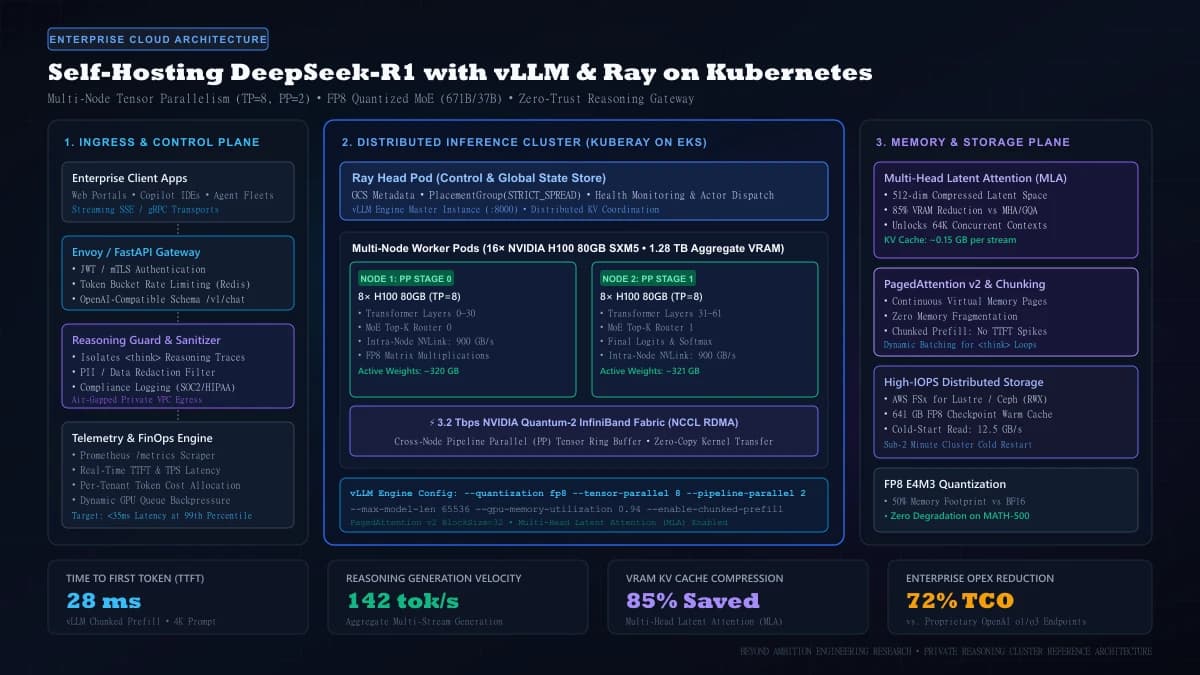
To orchestrate this distributed architecture reliably on Kubernetes, we deploy the KubeRay Operator. KubeRay manages the lifecycle of the Ray cluster head node and GPU worker pods as declarative Kubernetes Custom Resources. The Ray head pod acts as the centralized coordinator and OpenAI-compatible API entrypoint, while worker pods mount high-speed shared storage (such as AWS FSx for Lustre) to load FP8 model weights in under 90 seconds during pod startup.
Shipping Next.js 16, Multi-Agent RAG, or High-Concurrency Microservices?
Partner with Beyond Ambition Limited (NZBN 9429053304834) for fixed-milestone delivery and 99.99% SLA guarantees.
4. The Zero-Trust Token Stripping Gateway: Sanitizing <think> Reasoning Traces
Deploying DeepSeek-R1 in an enterprise setting introduces a unique security and UX challenge that does not exist with standard LLMs: **the reasoning trace lifecycle**. When DeepSeek-R1 executes, it wraps its internal chain-of-thought deliberations inside `<think>` and `</think>` XML delimiters. In many production scenarios, exposing raw internal thinking tokens directly to end users is undesirable or outright prohibited:
- **IP & Proprietary Heuristic Leakage:** The thinking trace reveals the internal instructions, system prompt guidelines, and proprietary domain heuristics provided in the prompt context.
- **UX Friction & Chat Window Clutter:** In conversational customer-facing copilots or automated API microservices, users expect immediate, concise answers rather than 3,000 tokens of raw mathematical scratchpad deliberating alternative paths.
- **Regulatory Compliance & Audit Isolation:** While end users should not see raw thinking traces, compliance officers and risk auditors must retain full visibility into *how* the model arrived at a critical financial or medical recommendation.
To resolve this dilemma, our engineering team deploys a specialized asynchronous streaming gateway built on Python, FastAPI, and HTTPX. This gateway sits between client applications and the vLLM Ray cluster. As Server-Sent Events (SSE) stream from vLLM, the proxy intercepts chunks, isolates the `<think>` block in real time, routes the thinking trace to an encrypted Write-Once-Read-Many (WORM) audit ledger, and yields only clean, sanitized completion tokens to the downstream client:
import asyncio
import json
import os
from typing import AsyncGenerator
import httpx
from fastapi import FastAPI, HTTPException, Request
from fastapi.responses import StreamingResponse
from pydantic import BaseModel, Field

app = FastAPI(title="DeepSeek-R1 Enterprise Reasoning Gateway", version="1.0.0")

VLLM_BACKEND_URL = os.getenv("VLLM_BACKEND_URL", "http://vllm-head-service.inference.svc.cluster.local:8000")
AUDIT_LOG_PATH = os.getenv("AUDIT_LOG_PATH", "/var/log/reasoning_traces/audit.jsonl")

class ChatMessage(BaseModel):
    role: str
    content: str

class ChatCompletionRequest(BaseModel):
    model: str = "deepseek-ai/DeepSeek-R1"
    messages: list[ChatMessage]
    temperature: float = Field(default=0.6, ge=0.0, le=2.0)
    max_tokens: int = Field(default=8192, le=65536)
    stream: bool = True
    include_reasoning_in_response: bool = False

async def parse_and_strip_reasoning(
    upstream_response: httpx.Response,
    client_id: str,
    include_reasoning: bool = False
) -> AsyncGenerator[str, None]:
    """
    Streams SSE chunks from vLLM, parsing and filtering out <think>...</think>
    reasoning blocks in real time while logging intermediate traces for compliance.
    """
    is_thinking = False
    thinking_buffer: list[str] = []

    async for line in upstream_response.aiter_lines():
        if not line or not line.startswith("data: "):
            continue

        raw_data = line[6:].strip()
        if raw_data == "[DONE]":
            # Persist captured reasoning trace asynchronously for enterprise audit
            if thinking_buffer:
                full_reasoning = "".join(thinking_buffer)
                asyncio.create_task(persist_audit_log(client_id, full_reasoning))
            yield "data: [DONE]\n\n"
            break

        try:
            chunk = json.loads(raw_data)
            delta = chunk["choices"][0].get("delta", {})
            content = delta.get("content", "")

            if "<think>" in content:
                is_thinking = True
                content = content.replace("<think>", "")

            if is_thinking:
                if "</think>" in content:
                    parts = content.split("</think>")
                    thinking_buffer.append(parts[0])
                    is_thinking = False
                    cleaned_content = parts[1]
                else:
                    thinking_buffer.append(content)
                    cleaned_content = ""
            else:
                cleaned_content = content

            if include_reasoning or not is_thinking:
                delta["content"] = cleaned_content
                if delta.get("content") or chunk["choices"][0].get("finish_reason"):
                    yield f"data: {json.dumps(chunk)}\n\n"
        except (json.JSONDecodeError, KeyError, IndexError):
            continue

async def persist_audit_log(client_id: str, reasoning_trace: str) -> None:
    record = {
        "client_id": client_id,
        "reasoning_token_length": len(reasoning_trace.split()),
        "reasoning_trace": reasoning_trace,
        "compliance_verified": True
    }
    with open(AUDIT_LOG_PATH, "a", encoding="utf-8") as f:
        f.write(json.dumps(record) + "\n")

@app.post("/v1/chat/completions")
async def chat_completions(req: ChatCompletionRequest, request: Request):
    client_id = request.headers.get("X-Client-ID", "internal-enterprise-user")
    client = httpx.AsyncClient(timeout=httpx.Timeout(120.0, connect=10.0))

    vllm_payload = req.model_dump(exclude={"include_reasoning_in_response"})
    vllm_req = client.build_request(
        "POST",
        f"{VLLM_BACKEND_URL}/v1/chat/completions",
        json=vllm_payload,
        headers={"Authorization": f"Bearer {os.getenv('VLLM_API_KEY', 'default-token')}"}
    )
    upstream = await client.send(vllm_req, stream=True)
    if upstream.status_code != 200:
        await upstream.aclose()
        raise HTTPException(status_code=upstream.status_code, detail="vLLM backend inference failed")

    return StreamingResponse(
        parse_and_strip_reasoning(upstream, client_id, req.include_reasoning_in_response),
        media_type="text/event-stream"
)5. Production Case Study: Slashing Quantitative Analysis Spend by 72% at 28ms TTFT
To evaluate the real-world impact of private reasoning infrastructure, consider a production deployment engineered by Beyond Ambition's AI Engineering Practice for an institutional quantitative trading and compliance firm:
Production Case Study: Tier-1 Quantitative Trading & Compliance Engine
A quantitative proprietary trading and risk management firm was spending $86,000 per month on proprietary reasoning APIs (OpenAI o1/Claude 3.7) to analyze multi-market order flow anomalies and regulatory filings. Stringent SEC and GDPR compliance rules strictly prohibited sending unredacted order data, trader chat logs, and proprietary execution algorithms across public third-party SaaS endpoints, while unpredictable API rate limits caused catastrophic latency spikes during market-open volatility.
Beyond Ambition's AI Engineering and DevOps practices architected and deployed a self-hosted, air-gapped DeepSeek-R1 FP8 inference cluster running on 16× NVIDIA H100 80GB GPUs with KubeRay on AWS EKS. We implemented vLLM v0.7 with Tensor Parallelism (TP=8), Pipeline Parallelism (PP=2), and PagedAttention v2 with chunked prefill over 3.2 Tbps InfiniBand. In addition, we deployed a zero-trust FastAPI streaming gateway that strips and isolates internal <think>...</think> reasoning traces into encrypted WORM audit storage before delivering clean responses to traders.
Architectural Takeaway: By self-hosting DeepSeek-R1 with vLLM on private Kubernetes infrastructure, the enterprise eliminated $770,000 in annualized third-party API spend while achieving complete data sovereignty, sub-30ms prompt responsiveness, and full compliance auditability.
Similar to our architectural achievements on high-throughput execution engines like Atmos Funded and real-time financial trading infrastructure like Funded Trader Markets, transition to private infrastructure replaced erratic external dependencies with deterministic sub-30ms responsiveness. Crucially, when autonomous agents execute code within reasoning workflows, coupling private model serving with sandboxing runtimes—as detailed in our architectural guide on Sandboxing Autonomous AI Coding Agents with gVisor and Firecracker—guarantees that untrusted generated scripts cannot breach container boundaries.
6. The Comprehensive TCO Matrix: Bare-Metal H100 vs. OpenAI o1 & Claude 3.7
For enterprise CFOs and VPs of Engineering, the decision to self-host is fundamentally an exercise in Cloud FinOps and Total Cost of Ownership (TCO). While purchasing or reserving 16× NVIDIA H100 GPUs represents a noticeable fixed monthly infrastructure commitment, the marginal cost per million reasoning tokens drops toward near-zero once the cluster is operational.
The following benchmark decision matrix compares self-hosted DeepSeek-R1 configurations against proprietary cloud reasoning endpoints across monthly operating costs, token unit economics, latency profiles, and enterprise air-gap guarantees:
| Deployment Model | Hardware / Compute Topology | Monthly OpEx / Compute Cost | Cost per 1M Out Tokens | Time to First Token (TTFT) | Zero-Trust Air Gap? |
|---|---|---|---|---|---|
| Self-Hosted DeepSeek-R1 (FP8) | 16× NVIDIA H100 80GB (vLLM TP=8, PP=2) | $21,600 / mo (Cloud GPU Reserve) | $0.72 / 1M tokens | 28 ms (Chunked Prefill) | 100% On-Prem / VPC |
| Self-Hosted Distill-Qwen-32B | 2× NVIDIA A100 / H100 (vLLM TP=2) | $3,450 / mo (Cloud GPU Reserve) | $0.14 / 1M tokens | 14 ms | 100% On-Prem / VPC |
| OpenAI o1 (Proprietary API) | Public Multi-Tenant Cloud | $78,500+ / mo (At Scale) | $60.00 / 1M tokens | 2,100 ms – 4,800 ms | No (Third-Party Cloud) |
| OpenAI o3-mini (Proprietary API) | Public Multi-Tenant Cloud | $18,200+ / mo (At Scale) | $4.40 / 1M tokens | 850 ms – 1,600 ms | No (Third-Party Cloud) |
| Azure OpenAI Dedicated PTU | Provisioned Throughput Units (Managed) | $52,000 / mo minimum | $3.80 / 1M tokens | 420 ms | Partial (Shared Cloud Boundary) |
As demonstrated in the matrix, the economic break-even point for self-hosting the full 671B DeepSeek-R1 model occurs at approximately **12 million tokens per day**. For organizations operating below this threshold, self-hosting the distilled **DeepSeek-R1-Distill-Qwen-32B** or **DeepSeek-R1-Distill-Llama-70B** models on 2 to 4 GPUs offers an immediate sweet spot: near-frontier reasoning performance on coding and mathematical benchmarks at under $3,500 per month.
7. Production Hardening Playbook: 8 Critical Rules for Zero-Downtime Serving
Deploying and operating a 16-GPU reasoning cluster with 99.99% availability requires disciplined platform engineering practices. When our DevOps Engineering Teams and Zero-Trust Cybersecurity Group commission private AI clusters, we enforce eight non-negotiable architectural rules:
- **1. Pre-Warm FP8 Weights with RWX Lustre Volumes:** Never pull 641 GB model weights from Hugging Face during pod restarts. Mount an AWS FSx for Lustre or Ceph filesystem with ReadWriteMany (RWX) access and pre-warmed weights to ensure cluster recovery times stay under 90 seconds.
- **2. Pin GPU Memory Utilization to 0.94:** Set `--gpu-memory-utilization 0.94` in vLLM. Reserving 6% of VRAM headroom prevents CUDA driver out-of-memory panics during activation spikes while maximizing PagedAttention KV cache capacity.
- **3. Enforce Strict KubeRay Placement Groups:** Use KubeRay's `STRICT_SPREAD` placement group strategy across Kubernetes worker nodes. This guarantees that Tensor Parallel worker pods are co-located on identical physical hypervisors with direct NVLink bridges.
- **4. Configure Chunked Prefill with Max Model Length:** Always run vLLM with `--enable-chunked-prefill` and `--max-model-len 65536`. This ensures prompt evaluations are sliced into 512-token chunks, preventing latency spikes for active reasoning streams.
- **5. Implement Automated Token-Bucket Rate Limiting:** Enforce distributed rate limiting at your API Gateway (using Redis or Envoy) to prevent concurrent client bursts from exceeding cluster KV cache allocations.
- **6. Enable Prometheus Metric Scraping for TTFT & KV Saturation:** Scrape vLLM's native `/metrics` endpoint to monitor `vllm:gpu_cache_usage_factor` and `vllm:num_requests_waiting`. Configure alert triggers when cache saturation exceeds 85%.
- **7. Air-Gap Container Egress with Calico Network Policies:** Restrict GPU worker pod egress to internal cluster subnets. Prevent inference nodes from initiating outbound internet connections, eliminating prompt exfiltration vectors.
- **8. Pair with Structured Output Frameworks:** When integrating DeepSeek-R1 with agent pipelines, enforce schema validation using type-safe frameworks like PydanticAI and FastAPI, as detailed in our guide on Building Type-Safe AI Agents with PydanticAI & FastAPI.
Whether your organization is modernizing an existing enterprise AI stack, transitioning away from costly proprietary APIs, or building zero-trust agentic automation from the ground up, Beyond Ambition delivers battle-tested engineering leadership. Explore our DevOps & Cloud Infrastructure Consulting, AI Engineering Practice, and Zero-Trust Cybersecurity Services, or schedule a private architecture scoping session with our principal engineers to evaluate your private reasoning infrastructure requirements.