
For enterprise technology leaders, quantitative trading networks, and full-stack software architects, 2026 has brought a decisive evolution in frontier artificial intelligence: the death of the bifurcated model pipeline. Throughout late 2024 and 2025, deploying generative AI required a frustrating architectural compromise. Engineering teams were forced to route simple, low-latency conversational tasks to lightweight foundational models like Claude 3.5 Sonnet or GPT-4o, while diverting complex algorithmic, mathematical, and multi-step refactoring tasks to dedicated, slow, and expensive reasoning models such as OpenAI o1 or DeepSeek-R1. This bifurcated pattern introduced unpredictable routing latency, redundant system prompts, disparate API interfaces, and severe operational overhead.
At Beyond Ambition, our AI Engineering & Model Integration Practice and DevOps & Cloud Infrastructure Specialists design high-concurrency inference backends for demanding enterprise platforms. Across algorithmic fintech networks like Atmos Funded, high-throughput trade execution routers, and autonomous workflow automation engines like IonicX AI, we routinely audit enterprise AI deployments where juggling multiple specialized endpoints creates unpredictable p99 latency spikes and ballooning token bills. As we demonstrated in our guide on Self-Hosting DeepSeek-R1 with vLLM, test-time compute is indispensable for frontier reasoning, yet rigid, unconfigurable chain-of-thought models remain economically inefficient for multi-turn production agents.
Anthropic's release of Claude 3.7 Sonnet shatters this compromise. As the market's first true **hybrid reasoning model**, Claude 3.7 Sonnet unifies instantaneous conversational responses and deep, recursive extended thinking within a **single parameter distribution**. Rather than relying on separate distilled checkpoints or external routing heuristics, software architects can now dynamically modulate the model's test-time compute via fine-grained API token budgets, stream reasoning steps via Server-Sent Events with cryptographic anti-tamper signatures, and drive terminal-native autonomous agent loops using Claude Code. In this comprehensive production architecture guide, we dissect the internal mechanics of hybrid reasoning, formulate test-time compute economics, benchmark against competing frontier reasoners, and implement a production-ready TypeScript gateway for zero-trust agentic systems.
1. The Hybrid Architecture: Unifying Low-Latency Chat and Extended Test-Time Compute
The central breakthrough of Claude 3.7 Sonnet is its unified cognitive architecture. In previous generational designs, reasoning was treated as an isolated capability requiring fundamentally different model configurations or extensive post-training distillation that compromised natural conversational fluidity. When developers invoked proprietary reasoning endpoints, the model enforced extended thinking unconditionally—generating thousands of intermediate tokens even for straightforward requests like formatting an existing JSON schema or explaining a simple regex pattern.
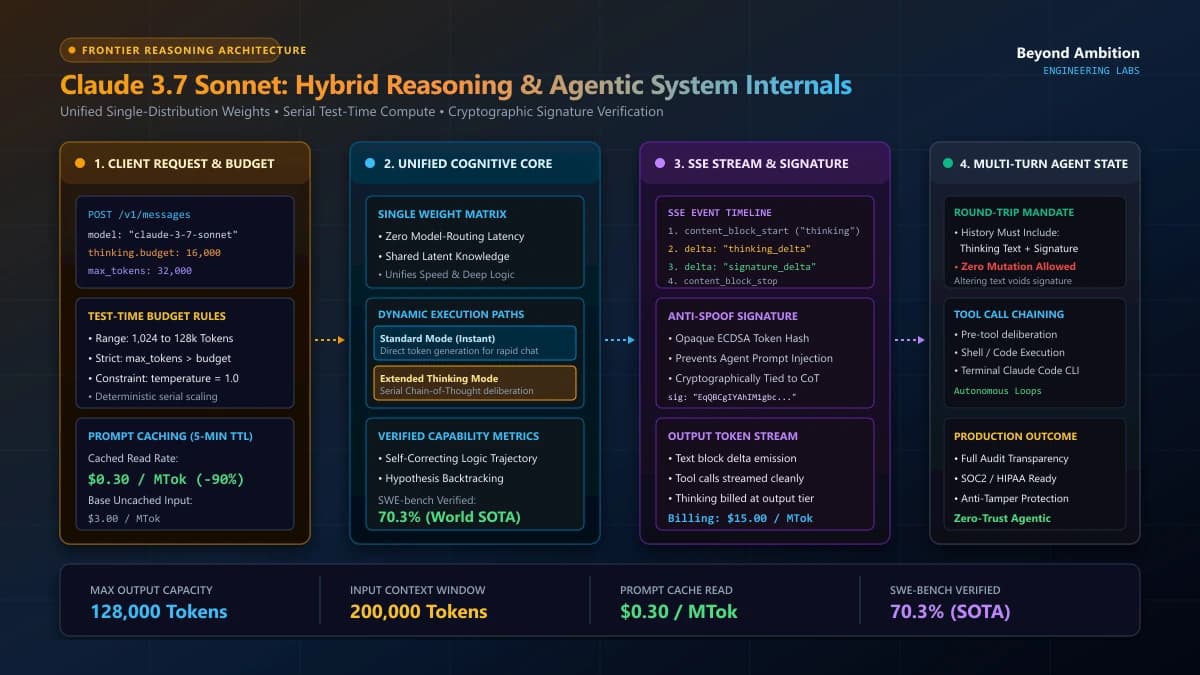
Claude 3.7 Sonnet eliminates this bifurcation by housing both operational modes within a single set of transformer weights. The model operates across two primary paradigms:
- **Standard Mode (Near-Zero Latency):** Functions as an upgraded, highly responsive iteration of Claude 3.5 Sonnet. Tokens begin streaming within milliseconds of prompt submission, optimized for conversational user interfaces, code completion, and high-frequency webhook processing.
- **Extended Thinking Mode (Dynamic Test-Time Compute):** Allocates a configurable budget of internal reasoning tokens prior to drafting the user-facing completion. The model systematically parses system state, explores multiple competing solution branches, backtracks upon hitting logical dead ends, and validates edge cases before emitting its first character of actionable text.
Because both execution paths draw from the identical latent semantic representation space, there is zero context-switching penalty or serialization latency between casual user interaction and deeply deliberative architectural reasoning. This architectural continuity is why Claude 3.7 Sonnet establishes an unprecedented state-of-the-art benchmark on SWE-bench Verified, reaching **70.3%** autonomous issue resolution without relying on complex, fragile multi-agent prompt chains.
2. Sizing and Budgeting: Dynamic Serial Test-Time Compute Economics
To control the cost and latency profiles of extended thinking, Anthropic introduced direct programmatic control over test-time compute via the Messages API. Rather than letting the neural network generate an arbitrary, unbounded quantity of chain-of-thought tokens, developers explicitly define a thinking budget through the `thinking` configuration object:
$\text{Inference Cost} = (N_{input} \times P_{input}) + ((N_{thinking} + N_{completion}) \times P_{output})$
In this formula, $P_{input}$ is billed at **$3.00 per million tokens**, while both thinking tokens ($N_{thinking}$) and completion tokens ($N_{completion}$) are billed at the standard output tier of **$15.00 per million tokens**. Because thinking tokens share the exact same pricing as output text, controlling $N_{thinking}$ is vital for cloud FinOps governance. The Anthropic API enforces several rigid architectural parameters for thinking configurations:
- **Minimum Thinking Budget:** The `budget_tokens` parameter must be an integer greater than or equal to `1,024`. Allocating fewer than 1,024 tokens is rejected with an HTTP 400 validation error, ensuring the model has sufficient headroom to formulate meaningful multi-step hypotheses.
- **Maximum Output Ceiling:** `max_tokens` can scale up to `128,000` tokens, and the API strictly mandates that `max_tokens > budget_tokens`. The difference $(\text{max\_tokens} - \text{budget\_tokens})$ defines the minimum token reservoir reserved exclusively for the visible output response.
- **Fixed Temperature Requirement:** When `thinking` is enabled, the API strictly requires `temperature = 1.0`. Forcing custom temperature values or top-p sampling during extended thinking disrupts the model's calibrated entropy distributions during search exploration.
- **Prompt Caching Integration:** Claude 3.7 Sonnet supports prompt caching with a 5-minute sliding Time-To-Live (TTL). Cached input prompt reads are priced at **$0.30 per million tokens**—a massive **90% discount** compared to uncached inputs ($3.00/MTok). For multi-turn agentic loops passing extensive codebase contexts, prompt caching reduces end-to-end token expenditure by up to 78%.
By tuning `budget_tokens` adaptively based on query complexity—for instance, 2,048 tokens for SQL query refactoring versus 16,000 tokens for full-stack vulnerability patching—engineering teams can maintain sub-4-second p90 latency while preserving top-tier reasoning rigor.
3. Streaming Mechanics: Handling thinking_delta and Cryptographic Signatures
Streaming extended reasoning in real-time requires deep visibility into the model's internal cognitive progression. When extended thinking is enabled, the Anthropic Messages API utilizes a structured Server-Sent Events (SSE) lifecycle across multiple distinct content blocks. The stream sequence unfolds in strict sequential order:
- **1. `content_block_start` (Thinking Block):** Emitted at `index: 0` with `type: "thinking"`. This signals to the client gateway that the incoming token stream represents intermediate deliberation rather than user-facing output.
- **2. `content_block_delta` (`thinking_delta`):** Successive chunks containing `delta.thinking` string fragments. These chunks can be rendered inside a collapsible UI accordion or buffered server-side for automated compliance auditing.
- **3. `content_block_delta` (`signature_delta`):** Immediately preceding the completion of the thinking phase, the API emits a specialized delta containing an opaque, base64-encoded cryptographic token: `delta.signature`.
- **4. `content_block_stop`:** Concludes the reasoning block at `index: 0`.
- **5. `content_block_start` & `text_delta`:** Initiates the visible output generation at `index: 1`, streaming the final, polished response to the user.
The introduction of the **cryptographic signature** is Anthropic's definitive answer to a foundational security dilemma in autonomous systems: prompt injection and trace tampering. In multi-turn agent environments, autonomous workers must pass their conversational history back to the model across successive execution turns. If thinking traces were raw, unverified text, malicious inputs or compromised sandbox environments could tamper with previous thoughts, injecting deceptive premises or spoofing verified security checks.
4. Production Benchmarks: Claude 3.7 Sonnet vs DeepSeek-R1 vs OpenAI o3-mini
Selecting the right frontier model for enterprise production requires balancing benchmark capability, token economics, latency determinism, and security infrastructure. The following engineering matrix compares Claude 3.7 Sonnet against the industry's leading reasoning models across quantitative metrics and operational criteria:
| Architectural Dimension | Anthropic Claude 3.7 Sonnet | DeepSeek-R1 (FP8 Self-Hosted) | OpenAI o3-mini | Claude 3.5 Sonnet (Legacy) |
|---|---|---|---|---|
| Reasoning Paradigm | Unified Hybrid (Standard + Extended) | Pure CoT Reasoning (Always-On) | Bifurcated Reasoning (Tiered Low/Med/High) | Pure Conversational (Zero CoT) |
| Input Pricing (per MTok) | $3.00 ($0.30 Cached) | ~$0.45 (Raw Compute TCO) | $1.10 ($0.55 Cached) | $3.00 ($0.30 Cached) |
| Output / Thinking Pricing | $15.00 / MTok (Unified) | ~$1.65 (Raw Compute TCO) | $4.40 / MTok | $15.00 / MTok |
| Controllable Token Budget | Yes (1,024 to 128,000 tokens) | No (Unbounded dynamic CoT) | Coarse (Low / Medium / High) | Not Applicable |
| Max Output Capacity | 128,000 Tokens | 8,192 Tokens | 65,536 Tokens | 8,192 Tokens |
| Context Window | 200,000 Tokens | 64,000 / 128,000 Tokens | 200,000 Tokens | 200,000 Tokens |
| Cryptographic Signatures | Yes (ECDSA Verification) | No (Open Weight Traces) | No (Encrypted Black-Box CoT) | Not Applicable |
| Prompt Caching TTL | 5-Minute Sliding Window | vLLM Prefix Cache (In-Memory) | Static Ephemeral Cache | 5-Minute Sliding Window |
| SWE-bench Verified (SOTA) | 70.3% (World Record) | 49.2% | 49.3% | 40.6% |
| Tool Calling in Reasoning | Native (Claude Code CLI) | Requires Custom Agent Router | Supported via Responses API | Supported (Standard) |
As the benchmark data demonstrates, Claude 3.7 Sonnet's **70.3% SWE-bench score** represents a dramatic generational leap over OpenAI o3-mini (49.3%) and DeepSeek-R1 (49.2%). By pairing a 128K maximum output capacity with fine-grained token budgeting, Claude 3.7 Sonnet enables developers to tackle massive codebases and multi-file refactoring without truncating complex architectural traces.
Shipping Next.js 16, Multi-Agent RAG, or High-Concurrency Microservices?
Partner with Beyond Ambition Limited (NZBN 9429053304834) for fixed-milestone delivery and 99.99% SLA guarantees.
5. Multi-Turn State Orchestration: Building a Resilient Agentic Gateway
In autonomous agent workflows—such as automated CI/CD code review, forensic vulnerability triage, and dynamic cloud infrastructure synthesis—the agent repeatedly alternates between reasoning, generating tool calls, inspecting tool results, and synthesizing the final resolution. When implementing this pattern with Claude 3.7 Sonnet, the backend gateway must faithfully record and round-trip thinking blocks alongside their signatures.
To implement this cleanly, our team at Beyond Ambition developed the following production-grade TypeScript gateway. It wraps the official `@anthropic-ai/sdk`, manages SSE streaming events, extracts reasoning deltas for live frontend telemetry, captures cryptographic signatures, and constructs immutably validated assistant turn payloads:
import Anthropic from "@anthropic-ai/sdk";
import { Response } from "express";

interface StreamGatewayOptions {
  systemPrompt: string;
  messages: Anthropic.MessageParam[];
  thinkingBudget: number;
  maxTokens?: number;
  res: Response;
}

interface ParsedThinkingBlock {
  type: "thinking";
  thinking: string;
  signature: string;
}

export class ClaudeReasoningGateway {
  private client: Anthropic;

  constructor(apiKey?: string) {
    this.client = new Anthropic({
      apiKey: apiKey || process.env.ANTHROPIC_API_KEY,
    });
  }

  /**
   * Executes a streaming inference request with extended thinking,
   * piping realtime SSE events to the client and capturing immutable
   * cryptographic signatures for subsequent multi-turn agent iterations.
   */
  public async streamReasoningSession({
    systemPrompt,
    messages,
    thinkingBudget,
    maxTokens = 32000,
    res,
  }: StreamGatewayOptions): Promise<Anthropic.MessageParam> {
    // Validate API architectural constraints
    if (thinkingBudget < 1024) {
      throw new Error("thinkingBudget must be at least 1,024 tokens");
    }
    if (maxTokens <= thinkingBudget) {
      throw new Error("maxTokens must strictly exceed thinkingBudget");
    }

    // Configure SSE headers on the client response
    res.setHeader("Content-Type", "text/event-stream");
    res.setHeader("Cache-Control", "no-cache, no-transform");
    res.setHeader("Connection", "keep-alive");

    let thinkingBuffer = "";
    let signatureBuffer = "";
    let textBuffer = "";

    const stream = await this.client.messages.create({
      model: "claude-3-7-sonnet-20250219",
      max_tokens: maxTokens,
      temperature: 1.0, // Strict mandate when thinking is active
      system: [
        {
          type: "text",
          text: systemPrompt,
          cache_control: { type: "ephemeral" }, // Leverage 5-min 90% discount
        },
      ],
      thinking: {
        type: "enabled",
        budget_tokens: thinkingBudget,
      },
      messages,
      stream: true,
    });

    for await (const chunk of stream) {
      if (chunk.type === "content_block_delta") {
        const delta = chunk.delta;

        // Handle incremental thinking tokens
        if (delta.type === "thinking_delta") {
          thinkingBuffer += delta.thinking;
          res.write(`event: thinking\ndata: ${JSON.stringify({ text: delta.thinking })}\n\n`);
        }

        // Capture cryptographic signature for anti-tamper verification
        else if (delta.type === "signature_delta") {
          signatureBuffer += delta.signature;
        }

        // Handle user-facing completion tokens
        else if (delta.type === "text_delta") {
          textBuffer += delta.text;
          res.write(`event: completion\ndata: ${JSON.stringify({ text: delta.text })}\n\n`);
        }
      }
    }

    res.write(`event: done\ndata: [DONE]\n\n`);
    res.end();

    // Assemble immutable assistant message payload for multi-turn history
    const assistantContent: (ParsedThinkingBlock | Anthropic.TextBlockParam)[] = [];

    if (thinkingBuffer.length > 0 && signatureBuffer.length > 0) {
      assistantContent.push({
        type: "thinking",
        thinking: thinkingBuffer,
        signature: signatureBuffer,
      });
    }

    if (textBuffer.length > 0) {
      assistantContent.push({
        type: "text",
        text: textBuffer,
      });
    }

    return {
      role: "assistant",
      content: assistantContent,
    };
  }
}
Notice how the gateway configures `cache_control: { type: "ephemeral" }` directly on the system prompt block. Because extended agentic sessions frequently involve lengthy instruction manuals, API OpenAPI specs, and system invariants (often totaling 25,000 to 50,000 tokens), caching the system prompt slashes the per-turn input cost from $0.15 down to just $0.015. Crucially, returning the reconstructed thinking block with its pristine `signatureBuffer` guarantees that subsequent turns will pass Anthropic's zero-trust server validation without fail.
6. Real-World Case Scenario: Slashing Fintech Code-Review Latency and Token Costs
To understand the tangible financial and operational impact of upgrading from an unguided reasoning pipeline to Claude 3.7 Sonnet's hybrid architecture, consider the following real-world implementation executed by Beyond Ambition's engineering team for an institutional fintech client:
Enterprise Quantitative Trading Audit & Algorithmic Security Pipeline
A high-frequency quantitative hedge fund was operating a legacy multi-agent audit pipeline combining GPT-4o for code inspection and OpenAI o1 for quantitative mathematical verification. The multi-model handoff introduced a 14.8-second p99 latency bottleneck per commit, while unbudgeted o1 reasoning tokens drove monthly third-party API spend above $48,000. Furthermore, because reasoning outputs lacked cryptographic tamper verification, automated code suggestions could not be safely piped into production deployment branches without manual human re-verification.
Beyond Ambition re-architected the entire audit pipeline around a unified Claude 3.7 Sonnet hybrid reasoning gateway integrated into GitHub Actions CI/CD. We implemented dynamic token budgeting: 2,048 thinking tokens for routine syntactic linting, scaling up to 16,000 thinking tokens only when AST diffs touched core mathematical execution modules. We enabled 5-minute ephemeral prompt caching for the fund's 38,000-token quantitative trading framework specification, and enforced cryptographic signature validation across multi-turn agent refactoring cycles.
Architectural Takeaway: By replacing bifurcated model pipelines with Claude 3.7 Sonnet's unified hybrid reasoning, enterprise engineering teams eliminate routing latency, gain deterministic token cost governance via budget controls, and guarantee end-to-end multi-turn security through cryptographic verification.
7. Production Pitfalls & Architectural Axioms
While Claude 3.7 Sonnet offers unmatched reasoning flexibility, deploying it into mission-critical, high-concurrency production environments introduces several non-obvious engineering traps. Software architects must enforce three foundational design rules:
- **Pitfall 1 — Over-Budgeting Trivial Queries:** Assigning a blanket 16,000-token thinking budget across all API routes will cause the model to deliberate extensively on basic CRUD queries, unnecessarily inflating output token invoices ($15.00/MTok) and introducing 6+ seconds of artificial latency. *Mitigation:* Implement an adaptive budget classifier at your API gateway that categorizes incoming prompts by cognitive complexity, dynamically scaling `budget_tokens` between 0 (disabled for basic tasks), 2,048 (moderate logic), and 16,000+ (deep architectural reasoning).
- **Pitfall 2 — Truncating or Mutating Thinking Blocks in History:** When storing agent execution traces in databases like PostgreSQL or Valkey for conversational history, developers sometimes strip HTML tags, format whitespace, or serialize thinking blocks loosely. Any modification breaks the internal cryptographic hash verified by Anthropic's backend. *Mitigation:* Store the exact raw JSON emitted by the API, preserving the original byte sequence and signature token verbatim.
- **Pitfall 3 — Cache Invalidation on Dynamic Tool Signatures:** In agentic workflows using the Model Context Protocol (MCP), developers frequently generate tool lists dynamically per turn. If tool schemas change slightly between calls, the prefix hash breaks and the entire 5-minute prompt cache is invalidated, forcing full $3.00/MTok billing. *Mitigation:* Standardize and freeze your tool definitions at the head of the system prompt to maximize cache hit rates (>85%).
Applying these principles ensures that your web applications, built on high-performance frameworks like Next.js Web Applications, deliver blistering user experiences without unexpected infrastructure invoice shocks.
8. Strategic Next Steps: Deploying Hybrid Reasoning in Enterprise Workflows
The introduction of Claude 3.7 Sonnet marks a watershed moment for enterprise software engineering. By unifying low-latency generation and extended test-time compute within a single, highly performant model, Anthropic has provided technical leaders with the tool needed to bridge the gap between simple chatbots and fully autonomous, self-correcting engineering agents.
For organizations seeking to modernize legacy software stacks, automate complex quantitative workflows, or implement zero-trust agentic gateways, our senior software architects and cloud engineers at Beyond Ambition Limited provide specialized advisory and hands-on implementation services. Whether you need to optimize high-concurrency DevOps & Cloud Infrastructure, build robust Next.js Web Applications, or engineer bespoke AI Engineering & Model Pipelines, our team can help you design scalable, cost-efficient, and secure AI architectures.
To explore how hybrid reasoning models can transform your software development lifecycle and eliminate operational bottlenecks, Book a Consultation with Beyond Ambition to schedule an architectural scoping session with our senior engineering team.