
Across enterprise engineering organizations in 2026, the era of evaluating generative artificial intelligence through isolated prompt templates or simplistic, single-turn Retrieval-Augmented Generation (RAG) pipelines has ended. Engineering leaders, principal cloud architects, and quantitative technology directors are now deploying autonomous multi-agent networks—collaborative clusters of specialized reasoning units capable of decomposing complex business requirements, querying corporate data lakes, invoking distributed APIs, and executing multi-step remediation playbooks without constant human steering.
However, transitioning autonomous agents from experimental Jupyter notebooks into fault-tolerant, SOC 2-compliant production environments reveals a severe architectural divide. In production, unconstrained language models frequently suffer from catastrophic failure modes: infinite conversational loops, non-deterministic state drift, unbounded token consumption, and unrecoverable runtime crashes when intermediate network calls fail. As our Enterprise AI Engineering & Multi-Agent Architecture Practice and DevOps & Cloud Infrastructure Practice observe across production client deployments, selecting the wrong agent orchestration runtime introduces systemic technical debt that degrades latency, inflates cloud FinOps expenditures, and jeopardizes system stability.
Across high-throughput enterprise platforms like IonicX AI for automated document workflow orchestration and Atmos Funded for algorithmic trading telemetry, our engineers have stress-tested the three dominant multi-agent orchestration frameworks: **LangGraph**, **Microsoft AutoGen 0.4**, and **CrewAI**. As we analyzed in our research on the Claude 3.7 Sonnet Hybrid Reasoning Architecture and Enterprise Model Context Protocol (MCP) Agent Gateway Architecture, raw model intelligence is insufficient without rigorous execution guarantees. In this architectural breakdown, we deconstruct the core runtime topologies of each framework, evaluate state persistence engines, formulate production token economics, and provide a hardened, PostgreSQL-checkpointed reference implementation for mission-critical enterprise systems.
1. Architectural Paradigms: Cyclic Graphs, Event-Driven Actors, and Role Hierarchies
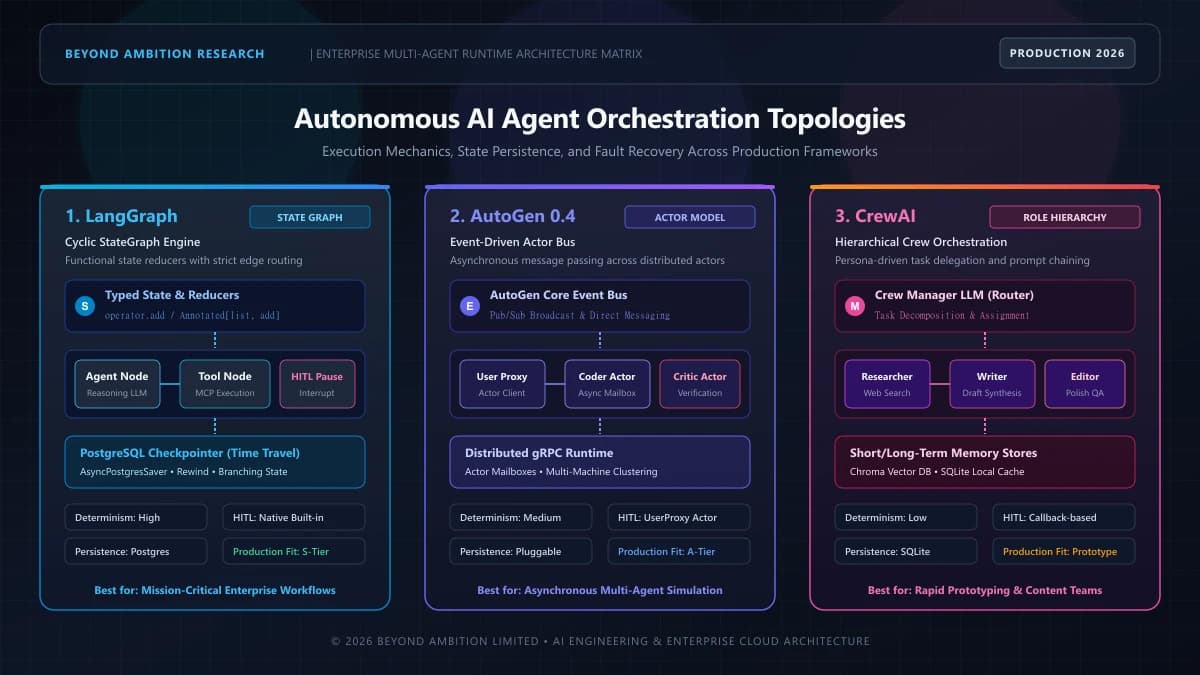
The foundational difference between LangGraph, AutoGen, and CrewAI lies not in their Python syntax, but in their underlying computation models. Each framework approaches agent collaboration through a fundamentally distinct computer science paradigm:
- **LangGraph (Cyclic StateGraph Engine):** Authored by LangChain, LangGraph rejects linear chain abstractions in favor of a mathematically formalized directed graph ($G = (V, E)$) supporting cyclical edge transitions. Every state mutation is governed by an explicit `StateGraph` definition where nodes represent functional compute steps and edges dictate deterministic routing logic. Crucially, state is centralized in a typed schema with functional reducers (such as `operator.add`), preventing concurrent nodes from clobbering shared context.
- **Microsoft AutoGen 0.4 (Distributed Event-Driven Actor Model):** In early 2025, Microsoft completely redesigned AutoGen from its legacy `ConversableAgent` pattern into an asynchronous, distributed actor runtime modeled on Erlang/Akka and Microsoft Orleans. Microsoft AutoGen 0.4 decouples agents into independent event-driven actors communicating via an asynchronous message bus over gRPC. Agents do not share memory; instead, they exchange strongly typed event messages through discrete mailboxes, enabling multi-machine agent clustering and distributed cloud deployments.
- **CrewAI v0.100+ (Hierarchical Role-Playing Agency):** CrewAI models agent interaction through organizational role-playing hierarchies inspired by human enterprise teams. Workflows are organized into `Crews`, which house specialized `Agents` (defined by `role`, `goal`, and `backstory`) and assign them sequential or hierarchically delegated `Tasks`. While intuitive for developers transitioning from prompt engineering, CrewAI abstracts the underlying execution graph, relying on a central Manager Agent LLM to dynamically route task execution.
For engineering architects, this topological divergence determines how systems behave under stress. In LangGraph, control flow is explicit and developer-defined: conditional edges evaluate the graph's state schema and deterministically branch to subsequent nodes, ensuring that an agent cannot arbitrarily invoke unauthorized tools or wander into non-terminating loops. Conversely, CrewAI delegates task routing to an LLM manager prompt, which introduces cognitive overhead and stochastic routing variance that can derail strict deterministic business logic.
2. State Persistence & Fault Tolerance: PostgreSQL Checkpointers vs Session Stores
In multi-step enterprise workflows—such as reconciling financial ledgers, drafting legal filings, or remediating infrastructure alerts—an autonomous execution loop may execute across dozens of steps, take hours to complete, or require human executive approval. A production agent framework must withstand worker container restarts, network partitions, and upstream LLM rate-limit exceptions without abandoning accumulated execution context.
LangGraph establishes the industry benchmark for state persistence through its native Checkpointer architecture. By attaching an `AsyncPostgresSaver` to the compiled graph, LangGraph automatically writes a full snapshot of the state schema, channel values, and pending writes to durable PostgreSQL storage at every super-step boundary:
- **Thread-Level Session Isolation:** Every execution thread is keyed by a unique `thread_id`. Multiple concurrent users or background automated pipelines run completely isolated state partitions within the same database tables without cross-talk.
- **Deterministic Time-Travel & State Rollback:** Because every state mutation is indexed by an immutable `checkpoint_id`, engineers can query historical checkpoints, rewind a stuck agent loop to step $N-2$, modify the state payload using `graph.update_state()`, and resume execution along an alternate branch.
- **Atomic Multi-Node Transactions:** In parallel fan-out architectures (e.g., dispatching three specialist research nodes simultaneously), LangGraph holds pending writes until all concurrent nodes complete, committing state via a single ACID-compliant database transaction.
In contrast, Microsoft AutoGen 0.4 handles persistence by serializing actor state envelopes and event streams. While highly performant for distributed microservices communicating across Kubernetes pods, implementing point-in-time state rewinds or conditional human steering requires substantial custom middleware. CrewAI traditionally relies on local SQLite databases and ChromaDB vector caches for short-term and long-term memory. In clustered, containerized environments managed by Kubernetes or AWS ECS, local SQLite file locks frequently corrupt under concurrent multi-tenant loads, necessitating significant operational engineering to migrate memory persistence to managed Redis or PostgreSQL backends.
3. Tool Routing & Protocol Integration: Standardizing on Model Context Protocol (MCP)
A major operational crisis facing enterprise agent adoption is the $N \times M$ tool integration problem. Historically, connecting $N$ agent frameworks to $M$ internal enterprise data sources (PostgreSQL databases, Snowflake warehouses, Salesforce APIs, GitHub repositories, and AWS cloud controllers) required writing custom tool wrappers for each framework's bespoke format. A tool authored for LangChain could not be natively invoked by AutoGen without brittle translation adapters.
In 2026, enterprise software architecture has converged on Anthropic's open-source Model Context Protocol (MCP). MCP provides a standardized JSON-RPC 2.0 client-server transport (over `stdio` or Server-Sent Events) that decouples agent orchestration runtimes from underlying execution tools:
- **LangGraph MCP Client Integration:** In LangGraph, MCP tools are wrapped into standard LangChain `BaseTool` interfaces. Because LangGraph supports fine-grained dynamic routing, an agent node can inspect tool schemas, query an external MCP gateway, and conditionally dispatch execution to isolated tool nodes without leaking database credentials into the LLM context window.
- **AutoGen 0.4 Distributed Tool Actors:** In AutoGen 0.4, MCP servers can be instantiated as standalone worker actors on dedicated network nodes. When an agent requests a database query, the request is published to the internal actor bus, processed by the isolated tool actor, and returned asynchronously, preventing rogue tool executions from hanging the agent runtime.
- **Runtime Sandboxing Requirements:** Irrespective of framework, exposing shell execution or database modification tools to autonomous agents introduces severe security risks. Production deployments must isolate tool execution within microVM boundaries using lightweight virtualization engines like Firecracker or gVisor, enforcing strict CPU, memory, and network egress policies.
When our cloud infrastructure team implements enterprise agent gateways, we standardize on centralized MCP proxies with mutual TLS (mTLS) authentication. This ensures that every tool call emitted by LangGraph, AutoGen, or CrewAI undergoes centralized audit logging, rate limiting, and role-based access control (RBAC) before touching production infrastructure.
4. Production Benchmark & Token Economics: Latency, Divergence Risk, and TCO
Deploying multi-agent architectures at scale introduces significant financial and performance implications. Unlike single-turn LLM calls where costs scale linearly with user prompt volume, multi-agent systems exhibit **token amplification**: an initial user prompt of 500 tokens can easily generate 15,000 to 45,000 intermediate reasoning, conversation, and reflection tokens as multiple agents debate and summarize findings.
The following evaluation matrix synthesizes architectural metrics, operational latency, and Total Cost of Ownership (TCO) benchmarks recorded across enterprise client workloads:
| Evaluation Dimension | LangGraph (LangChain) | Microsoft AutoGen 0.4 | CrewAI v0.100+ |
|---|---|---|---|
| Core Execution Model | Deterministic Cyclic StateGraph (Nodes & Edges) | Asynchronous Event-Driven Distributed Actor Bus | Role-Playing Sequential & Hierarchical Crew Teams |
| State Persistence Engine | Durable PostgreSQL Checkpointer (AsyncPostgresSaver) | Pluggable Actor Message Serialization & Event Store | Local SQLite Cache with ChromaDB Vector Memory |
| Cycle & Loop Control | Strict recursion_limit with deterministic conditional edges | Configurable max_turns with event termination signals | Max iterations per task with manager LLM oversight |
| Human-in-the-Loop (HITL) | Native interrupt_before and interrupt_after breakpoints | UserProxy actor with interactive console or socket callback | Step callback functions with human input prompt gates |
| Token Amplification Factor | 1.8x – 3.2x (Minimal redundant conversational overhead) | 3.5x – 6.8x (Chat loops re-inject full message history) | 4.0x – 7.5x (Manager delegation prompts add heavy token bloat) |
| p95 Workflow Latency | 4.2s – 8.5s (High concurrency, parallel node execution) | 6.8s – 14.2s (Asynchronous message bus dispatch) | 9.5s – 21.0s (Sequential manager evaluation passes) |
| Clustered Cloud Readiness | S-Tier (Stateless worker pods backed by Postgres DB) | A-Tier (Native gRPC multi-node distributed clustering) | B-Tier (Requires custom architectural adapters for clustering) |
| Estimated TCO ($/1K Workflows) | $42.50 – $78.00 (Highly optimized prompt caching compatibility) | $95.00 – $185.00 (Redundant chat token exchanges) | $110.00 – $220.00 (Manager prompt overhead and repeated context) |
From a pure FinOps perspective, LangGraph demonstrates superior cost efficiency for enterprise backends. Because LangGraph separates node compute from conversational history, architects can structure state schemas to pass only the exact payload deltas required by downstream tools. In contrast, conversational multi-agent runtimes repeatedly exchange full dialogue transcripts between agents, quickly exhausting prompt caching windows and dramatically increasing inference bills.
Shipping Next.js 16, Multi-Agent RAG, or High-Concurrency Microservices?
Partner with Beyond Ambition Limited (NZBN 9429053304834) for fixed-milestone delivery and 99.99% SLA guarantees.
5. Real-World Case Study: Autonomous Trade Reconciliation & Audit Pipeline
To evaluate these architectural trade-offs in a demanding commercial environment, consider the real-world engineering challenge of institutional trade settlement and compliance audit reconciliation:
Autonomous Institutional Trade Reconciliation & Anomaly Resolution
A cross-border proprietary trading firm handling 85,000 daily equity and derivative executions experienced frequent settlement mismatches between internal order books, prime broker clearing feeds, and SWIFT confirmation messages. The existing legacy Python reconciliation script flagged over 1,200 false-positive discrepancy tickets daily, requiring a 14-person operations team to manually investigate trade blotters, query liquidity provider APIs, and generate audit reports. Attempting to automate this with conversational multi-agent chat loops caused frequent infinite loops, where researcher and critic agents argued over rounding discrepancies without reaching deterministic closure.
Beyond Ambition engineered an enterprise LangGraph multi-agent reconciliation pipeline backed by an AsyncPostgresSaver checkpointer on Amazon Aurora PostgreSQL. The architecture features an Ingestion Node that normalizes trade feeds, an Anomaly Detection Node that computes mathematical discrepancies, and parallel MCP specialist nodes querying broker APIs. If a discrepancy exceeds $10,000 or involves ambiguous counterparty allocations, the graph triggers an interrupt_before breakpoint, writing state to PostgreSQL and alerting compliance officers via a Next.js dashboard. Once approved, the human reviewer pushes a signed payload delta, and the graph resumes execution to commit the journal entry.
Architectural Takeaway: In mission-critical, regulated industries, conversational chat loops are a production liability. Deterministic state graphs with explicit conditional routing, strict recursion limits, and durable PostgreSQL checkpointing provide the mathematical predictability and auditability required for enterprise compliance.
6. Production Implementation: Building a Resilient LangGraph StateGraph with PostgreSQL Checkpointing
Below is a complete, production-grade Python reference architecture demonstrating how senior software engineers construct a resilient multi-agent StateGraph with typed state schemas, functional reducers, Model Context Protocol tool execution, and durable PostgreSQL checkpointing:
# Production LangGraph Multi-Agent Architecture with PostgreSQL Checkpointing
# Requirements: langgraph>=0.2.70, langchain-core>=0.3.30, psycopg-pool>=3.2.0

import operator
from typing import Annotated, TypedDict, Literal, List, Dict, Any
from dataclasses import dataclass
from langchain_core.messages import BaseMessage, HumanMessage, AIMessage, SystemMessage
from langchain_core.tools import tool
from langgraph.graph import StateGraph, END, START
from langgraph.checkpoint.postgres.aio import AsyncPostgresSaver
from psycopg_pool import AsyncConnectionPool

# 1. Define Strongly Typed Agent State Schema with Functional Reducers
class EnterpriseAgentState(TypedDict):
    task_id: str
    client_id: str
    messages: Annotated[List[BaseMessage], operator.add]
    intermediate_steps: Annotated[List[Dict[str, Any]], operator.add]
    reconciliation_data: Dict[str, Any]
    risk_score: float
    requires_human_approval: bool
    audit_log: Annotated[List[str], operator.add]

# 2. Production Tool Definitions (Representing MCP Gateway Connectors)
@tool
def query_liquidity_ledger(trade_ref: str) -> str:
    """Queries institutional liquidity ledger for settlement clearing status."""
    # In production, this executes via an authenticated Model Context Protocol (MCP) client
    return f"Ledger match verified for trade {trade_ref}. Status: EXECUTED. Mismatch Delta: $0.00."

# 3. Deterministic Node Implementations
async def ingest_and_audit_node(state: EnterpriseAgentState) -> Dict[str, Any]:
    """Parses transaction data, evaluates risk parameters, and initializes audit trail."""
    trade_id = state.get("task_id", "UNKNOWN")
    raw_delta = state.get("reconciliation_data", {}).get("mismatch_amount", 0.0)

    # Calculate quantitative risk score
    risk_score = 0.85 if raw_delta > 10000.0 else 0.15
    requires_review = risk_score > 0.50

    audit_entry = f"IngestionNode: Processed {trade_id}. Delta: ${raw_delta:,.2f}. Risk: {risk_score:.2f}."
    return {
        "risk_score": risk_score,
        "requires_human_approval": requires_review,
        "audit_log": [audit_entry],
        "messages": [AIMessage(content=f"Evaluated trade {trade_id}. Risk score: {risk_score:.2f}.")]
    }

async def specialist_investigation_node(state: EnterpriseAgentState) -> Dict[str, Any]:
    """Executes specialized API lookups across clearing feeds via MCP tools."""
    trade_ref = state.get("task_id", "REF-001")
    tool_result = query_liquidity_ledger.invoke({"trade_ref": trade_ref})

    audit_entry = f"InvestigationNode: Queried liquidity ledger. Output: {tool_result}"
    return {
        "intermediate_steps": [{"tool": "query_liquidity_ledger", "result": tool_result}],
        "audit_log": [audit_entry],
        "messages": [AIMessage(content=f"Investigation completed: {tool_result}")]
    }

async def compliance_human_review_node(state: EnterpriseAgentState) -> Dict[str, Any]:
    """Breakpoint node reached only after human officer approval or state update."""
    audit_entry = "ComplianceNode: Executive human-in-the-loop approval confirmed. Committing journal."
    return {
        "audit_log": [audit_entry],
        "messages": [AIMessage(content="Trade reconciliation committed to general ledger.")]
    }

# 4. Conditional Edge Routing Logic
def route_reconciliation_flow(state: EnterpriseAgentState) -> Literal["compliance_human_review", "specialist_investigation", "__end__"]:
    """Evaluates state parameters to enforce strict deterministic branching."""
    if state.get("requires_human_approval", False):
        return "compliance_human_review"

    # If risk is low but verification steps remain incomplete
    if len(state.get("intermediate_steps", [])) == 0:
        return "specialist_investigation"

    return END

# 5. Graph Compilation with PostgreSQL Checkpointing & HITL Breakpoints
async def build_production_agent_graph(db_connection_string: str):
    # Establish resilient async connection pool
    pool = AsyncConnectionPool(conninfo=db_connection_string, max_size=20)
    checkpointer = AsyncPostgresSaver(pool)

    # Ensure database checkpoint migrations are executed
    await checkpointer.setup()

    workflow = StateGraph(EnterpriseAgentState)

    # Register Graph Nodes
    workflow.add_node("ingest_and_audit", ingest_and_audit_node)
    workflow.add_node("specialist_investigation", specialist_investigation_node)
    workflow.add_node("compliance_human_review", compliance_human_review_node)

    # Configure Edge Transitions
    workflow.add_edge(START, "ingest_and_audit")
    workflow.add_conditional_edges(
        "ingest_and_audit",
        route_reconciliation_flow,
        {
            "compliance_human_review": "compliance_human_review",
            "specialist_investigation": "specialist_investigation",
            "__end__": END
        }
    )
    workflow.add_edge("specialist_investigation", END)
    workflow.add_edge("compliance_human_review", END)

    # Compile graph with persistence and human approval interrupt gate
    app = workflow.compile(
        checkpointer=checkpointer,
        interrupt_before=["compliance_human_review"]  # Pauses execution before committing sensitive state
    )
    return app
In this implementation, the `interrupt_before=["compliance_human_review"]` configuration guarantees that sensitive financial actions cannot execute autonomously. When the graph encounters a high-risk trade, execution halts immediately at the boundary of `compliance_human_review`. The entire memory envelope is committed to PostgreSQL under the active `thread_id`. Human operators can inspect the ledger deltas via a web interface, approve or adjust parameters using `app.update_state(config, {"requires_human_approval": False})`, and trigger `app.ainvoke(None, config)` to cleanly resume execution.
7. Production Failure Modes & Security Hardening
Deploying multi-agent systems without defensive engineering safeguards inevitably leads to production incidents. When auditing enterprise agent architectures, our Emergency Production Debugging & Incident Remediation Team routinely diagnoses three recurring structural vulnerabilities:
- **Infinite Recursive Loop Divergence:** In conversational frameworks where agents debate solutions (e.g., AutoGen or CrewAI), agents frequently enter semantic deadlocks where Agent A rejects Agent B's formatting, and Agent B apologizes and resubmits the identical proposal. Left unchecked, this drains API rate limits and generates four-figure token bills in minutes. In LangGraph, developers must always configure a hard `recursion_limit` in the invocation config (`{"recursion_limit": 25}`), while establishing deterministic termination nodes that trigger graceful fallback queues.
- **State Divergence and Memory Bloat:** Storing full conversation transcripts inside state channels without summarization rapidly causes token exhaustion. As the context window fills with hundreds of redundant tool observations, model reasoning fidelity degrades sharply due to 'lost in the middle' attention decay. Implement sliding window truncation and store large raw payloads (such as 10MB PDF extractions or database dumps) in Amazon S3 or Redis, referencing only immutable UUID handles within the agent state graph.
- **Indirect Prompt Injection & Privilege Escalation:** When an agent fetches untrusted external data (such as web search results or customer emails) and passes it directly to a downstream agent equipped with sensitive tool capabilities (such as executing SQL mutations or triggering cloud deployments), malicious text can hijack the agent's intent. Enterprise architectures must implement strict **dual-boundary privilege separation**: untrusted data must be parsed by a zero-privilege 'Reader Agent' that outputs a validated Pydantic schema, which is then verified before being handed to an authenticated 'Executor Agent'.
8. Enterprise Selection Playbook: Choosing the Right Framework for Your Architecture
To determine the optimal framework for your organization's engineering roadmap, evaluate your project against these concrete architectural criteria:
- **Select LangGraph If:** You are building mission-critical backend microservices, transactional workflow engines, financial/legal compliance pipelines, or systems that require deterministic routing, auditable PostgreSQL state persistence, fine-grained Model Context Protocol tool execution, and native human-in-the-loop checkpoints. LangGraph is the premier industry standard for enterprise software engineering teams requiring total control over execution mechanics.
- **Select Microsoft AutoGen 0.4 If:** Your objective is simulating complex multi-agent collaborative dynamics, research ideation panels, software engineering coding/testing pairs, or distributed microservice meshes where agents run as independent background daemons communicating asynchronously across multiple Kubernetes clusters.
- **Select CrewAI If:** You are rapidly prototyping internal productivity assistants, automated content synthesis pipelines, or marketing research crews where role-based personification is intuitive, project timelines are measured in days rather than quarters, and execution risks can be tolerated without strict state machine guarantees.
Navigating the trade-offs of autonomous multi-agent orchestration, model sandboxing, and enterprise cloud infrastructure requires deep architectural expertise. Whether you are transitioning brittle prototype agents into scalable, production-grade microservices or architecting a zero-trust Model Context Protocol gateway, our team at Beyond Ambition Limited can help. Explore our Enterprise AI Engineering & Multi-Agent Architecture Practice, audit our DevOps & Cloud Infrastructure Practice, or schedule a dedicated multi-agent architecture consultation to design a resilient, high-throughput AI system engineered for scale.