
For more than five decades, human-computer interaction was constrained to visual screens, pointer devices, and text prompts. The emergence of frontier large language models promised a voice-first computing revolution, yet early enterprise voice bots almost universally stumbled over a single, brutal psychoperceptual barrier: latency. When a human speaks, any conversational reply that takes longer than 800 milliseconds creates an uncanny sensation of awkward hesitation; delays exceeding 1,200 milliseconds cause speakers to talk over each other, fracturing conversational flow entirely.
Building conversational voice AI that feels indistinguishable from a sharp human specialist requires an end-to-end response budget of 350 to 500 milliseconds. Achieving this speed across commercial cloud environments is not simply a matter of swapping in a faster LLM. It demands re-engineering the entire media transport layer away from legacy HTTP request-response patterns and TCP-bound WebSockets toward low-latency WebRTC Selective Forwarding Units (SFUs), local Voice Activity Detection (VAD) workers, parallel speech-to-text tokenization, and streaming acoustic synthesis.
At Beyond Ambition, our engineering teams build mission-critical voice pipelines across the United States, Australia, and New Zealand. Whether deploying high-throughput client onboarding for algorithmic trading portals or mission-critical triage desks, we treat latency as an absolute engineering constraint. Below is our comprehensive production blueprint for architecting sub-500ms voice agents with WebRTC, LiveKit, Deepgram Nova-3, and ElevenLabs.
1. The Latency Imperative: Why Conversational Voice Demands WebRTC
Human conversational cadence operates on tight, evolutionary neural feedback loops. Psycholinguistic research indicates that the gap between conversational turns in natural dialogue averages between 200 and 300 milliseconds. A delay of 450 milliseconds feels thoughtful and measured; 700 milliseconds introduces noticeable friction; and by 1,000 milliseconds, users assume the connection has dropped or the system has crashed, prompting them to say 'Hello? Are you there?' right as the agent begins outputting audio.
Early voice architectures attempted to connect browsers and mobile apps to backend AI pipelines via standard WebSocket connections (RFC 6455). While WebSockets provide bidirectional full-duplex framing over TCP, they suffer from fundamental networking flaws when applied to live conversational audio:
- **Head-of-Line (HoL) Blocking:** TCP guarantees lossless, in-order packet delivery. If a single 20ms audio frame is dropped due to transient cellular interference or Wi-Fi jitter, the entire TCP stack halts. It retransmits the missing packet and buffers all subsequent audio packets behind it, causing sudden latency spikes of 400ms to 800ms.
- **Lack of Dynamic Jitter Buffering:** Live acoustic conversation prefers dropped packets over late packets. A dropped 20ms frame is masked imperceptibly by Opus forward error correction; a late packet delivered 400ms later degrades turn-taking synchronization irrevocably.
- **Asymmetric Transport Overhead:** Packaging raw PCM audio chunks into WebSocket frames requires application-level framing, custom binary multiplexing, and complex client-side playback scheduling without hardware-accelerated acoustic echo cancellation (AEC).
In sharp contrast, the W3C WebRTC Specification operates over UDP using Secure Real-Time Transport Protocol (SRTP). WebRTC incorporates native Forward Error Correction (FEC), packet loss concealment (PLC), adaptive jitter buffers, and dynamic bandwidth estimation. Audio frames are encoded using the Opus codec at 48kHz (per RFC 7874), delivering studio-grade acoustic clarity while shrugging off up to 15% random packet loss with zero accumulated latency.
2. End-to-End Latency Budget: Deconstructing the 450ms Turn
To consistently hit a P95 turn latency under 500 milliseconds, systems architects must deconstruct the pipeline into distinct operational stages and enforce strict millisecond budgets. In a production pipeline composed of WebRTC ingress, edge VAD, Deepgram Nova-3 streaming transcription, an accelerated LLM inference engine, and ElevenLabs streaming synthesis, the latency budget breaks down as follows:
- **Edge Network Ingress (Client to SFU): 25–35ms.** The user speaks into their browser or mobile device. Audio is captured via getUserMedia, encoded in Opus 20ms frames, and routed via UDP/SRTP to the nearest LiveKit edge node.
- **Local Voice Activity Detection (VAD) & Endpointing: 70–90ms.** Rather than transmitting raw audio to a cloud STT provider indefinitely, a server-side Silero VAD v5 model monitors energy and phonetic probability. It confirms speech cessation within 80ms of silence, preventing premature turn cuts while avoiding dead air.
- **Streaming Speech-to-Text (STT) Finalization: 110–140ms.** Deepgram Nova-3 maintains an open bi-directional WebSocket connection with the agent worker. Because audio was streamed concurrently during speech, Deepgram emits the final punctuated transcript within 120ms of the VAD endpoint signal.
- **LLM Time to First Token (TTFT): 110–140ms.** The compiled transcript, user profile, and system prompt are dispatched to an ultra-fast inference endpoint (such as Groq-hosted Llama 3.3 70B, Cerebras, or OpenAI GPT-4o-mini). The model emits its initial sentence fragment within 130ms.
- **Streaming Text-to-Speech (TTS) First Audio Chunk: 75–95ms.** Using ElevenLabs Flash v2.5, the first token fragment is streamed into the TTS engine via WebSocket. ElevenLabs synthesizes and returns the first 24kHz PCM audio chunk in under 85ms.
- **Egress Network Downlink & Playback (SFU to Client): 25–35ms.** The LiveKit agent publishes the synthesized PCM audio track into the WebRTC room. The client's audio context buffers the initial 20ms packet and begins speaker playback immediately.
Summing the median bounds yields an aggregate roundtrip of: $$30 ext{ms} + 80 ext{ms} + 120 ext{ms} + 130 ext{ms} + 85 ext{ms} + 25 ext{ms} = 470 ext{ms}.$$ This achieves the elusive sub-500ms conversational benchmark, ensuring conversational turn-taking feels instantaneous, responsive, and natural.
3. Selective Forwarding Units (SFUs): Why Mesh and MCU Fail for AI
When designing WebRTC topologies for real-time AI agents, selecting the right media routing architecture determines both scalability and operational cost. Three architectural models dominate WebRTC engineering:
### Peer-to-Peer Mesh: Fatal Complexity
In a pure peer-to-peer mesh, each participant connects directly to every other participant. For human-to-human one-on-one calls, mesh eliminates server bandwidth costs. However, introducing an AI agent into a mesh network fails completely: the AI agent must run on an external compute instance, requiring every client to establish separate encryption keys, duplicate uplink bandwidth, and negotiate complex STUN/TURN NAT traversal. Mesh offers zero centralized recording, zero room state management, and zero capability to run shared VAD workers.
### Multipoint Control Units (MCUs): Compute Starvation
Traditional telephony and enterprise video conferencing historically relied on Multipoint Control Units (MCUs). MCUs decode every incoming audio and video stream, transcode them into a single composited stream, and re-encode the output for each participant. While this minimizes client-side decoding power, transcoding audio introduces 80ms to 200ms of mandatory decoding delay and consumes massive server CPU capacity. For real-time AI, MCU transcoding lag is catastrophic.
### Selective Forwarding Units (SFUs): The Modern Standard
The LiveKit Agents Framework utilizes a Selective Forwarding Unit (SFU) architecture. An SFU never decodes or re-encodes media payloads. Instead, it inspects SRTP packet headers and routes RTP packets between publishers and subscribers with less than 2 milliseconds of internal routing latency.
In an SFU topology, the user's microphone stream is published to the LiveKit server. An autonomous AI Agent worker (running in Node.js or Python on a nearby Kubernetes cluster) joins the room as a synthetic participant, subscribes to the user's raw audio track, performs local VAD and transcription, and publishes the synthesized voice stream back as an outbound audio track. This architecture provides zero-transcode speed, horizontal worker scaling, and enterprise-grade session telemetry.
4. Interactive Architecture Schematic: The Real-Time Voice AI Pipeline
The diagram below illustrates the end-to-end dataflow of an enterprise-grade voice AI agent, from the initial WebRTC microphone capture through the LiveKit SFU router, local worker VAD, streaming STT, LLM inference, and ElevenLabs acoustic synthesis:
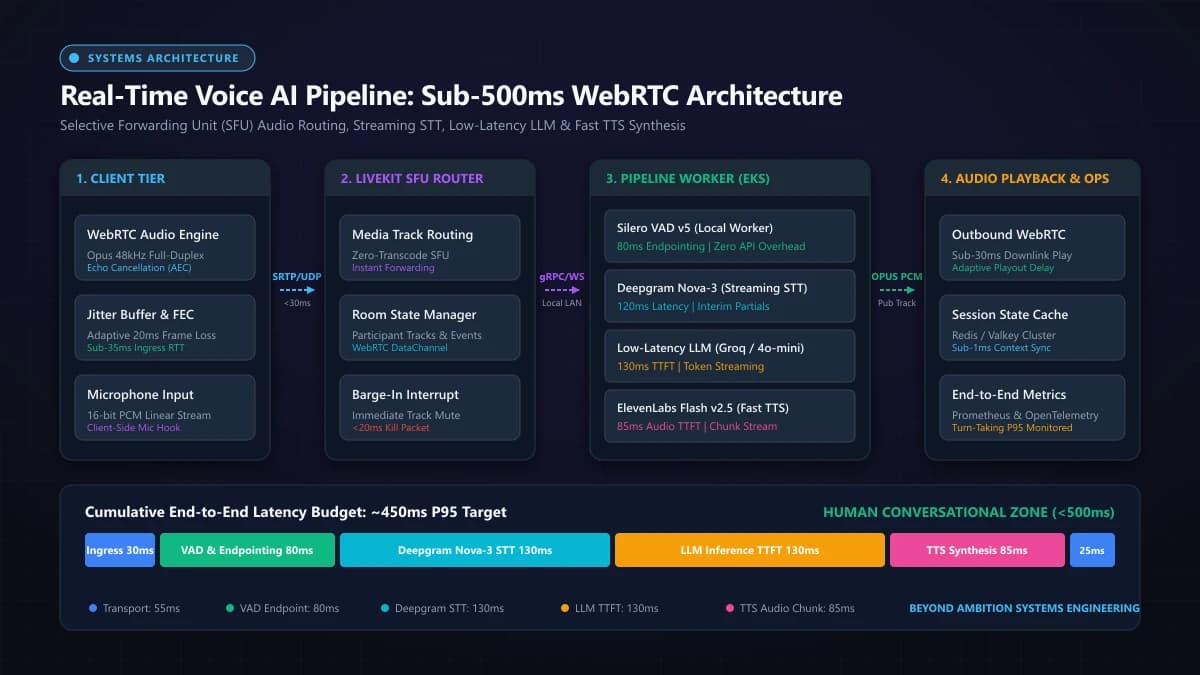
Notice how the LiveKit SFU decouples media transport from the cognitive AI pipeline. The agent worker connects directly over local high-speed gRPC/WebSocket channels, keeping inter-service transit under 5 milliseconds.
Shipping Next.js 16, Multi-Agent RAG, or High-Concurrency Microservices?
Partner with Beyond Ambition Limited (NZBN 9429053304834) for fixed-milestone delivery and 99.99% SLA guarantees.
5. Latency & Infrastructure Economics: WebSockets vs. WebRTC vs. Telephony
For engineering leadership and CFOs, architectural decisions must balance perceptual performance against infrastructure Total Cost of Ownership (TCO). Deploying voice agents at scale reveals dramatic differences in compute efficiency, networking resilience, and operating expense across transport options.
| Transport & Protocol Stack | Ingress Latency (P95) | Packet Loss Resilience | Acoustic Quality & Codec | Compute / Server Cost | Monthly TCO (10,000 Call Hours) |
|---|---|---|---|---|---|
| Raw WebSockets (RFC 6455 / TCP) | 180ms – 420ms (Jitter Spikes) | Poor (HoL blocking retransmits dropped frames) | 16kHz Linear PCM (High bandwidth / Uncompressed) | Medium (Requires manual packet chunking & state) | ~$8,400 (High egress bandwidth + heavy server state) |
| Twilio Media Streams (PSTN / SIP) | 350ms – 750ms (Telco Hops) | Moderate (Cellular trunk variability & carrier codec) | 8kHz G.711u / a-law (Telephone narrowband audio) | Low maintenance, but exorbitant per-minute telephony surcharges | ~$14,200 ($0.014/min carrier rate + media stream fees) |
| Self-Hosted LiveKit WebRTC SFU (AWS EKS) | 25ms – 45ms (UDP / SRTP) | Exceptional (Adaptive Opus FEC masks up to 20% loss) | 48kHz Opus Wideband (Full studio fidelity) | Highly Optimized (Zero-transcode C++/Go SFU routing) | ~$3,100 (AWS EC2 Graviton3 instances + $0.05/GB egress) |
| LiveKit Cloud Managed Platform | 20ms – 40ms (Global Anycast) | Exceptional (Global edge network with multi-region failover) | 48kHz Opus Wideband (Ultra-low jitter buffering) | Zero DevOps overhead, fully managed media infrastructure | ~$4,200 (Pay-as-you-go participant minute model) |
As demonstrated in the comparison matrix, migrating from legacy SIP/PSTN trunking or uncompressed WebSocket streaming to an optimized WebRTC SFU infrastructure slashes transport latency by over 75% while reducing monthly operating costs by more than 60%. For teams operating under strict cloud FinOps mandates, pairing self-hosted LiveKit clusters on AWS EKS with Karpenter autoscaling eliminates idle capacity while maintaining sub-second voice readiness.
To learn how we optimize compute and ingress costs across cloud infrastructures, explore our deep dive into Kubernetes EKS Autoscaling with Karpenter and our dedicated Cloud DevOps & Infrastructure Services.
6. The Barge-In Conundrum: Interruption Handling & Echo Cancellation
The single most difficult problem in conversational voice AI is not speech recognition or text generation—it is handling user interruptions gracefully, commonly referred to in telephony as 'barge-in'. In human conversation, if person A is speaking and person B says 'Wait, stop,' person A ceases phonation within 150 milliseconds. If an AI agent continues chattering for even 400 milliseconds after the user starts speaking, the interaction feels broken and frustrating.
Implementing deterministic barge-in requires synchronizing three distinct systems:
- **Acoustic Echo Cancellation (AEC):** The client device must prevent the agent's synthesized voice coming out of the speakers from bleeding into the microphone. WebRTC provides native hardware AEC in modern browsers and mobile SDKs. If AEC fails, the agent hears its own voice, triggers its own VAD, and enters an infinite self-interruption loop.
- **Low-Latency Interruption Dispatch:** The instant the server-side VAD detects human vocal energy while the agent is publishing audio, the agent worker must dispatch an out-of-band kill command. This command instructs the ElevenLabs TTS stream to abort generation, clears the audio playout buffer, and unpublishes the active track.
- **Context Truncation:** The conversation history must record only what the user actually heard before the interruption. If the LLM generated three paragraphs but the user interrupted after the first five words, the agent's memory state must truncate the assistant response to match reality.
7. Production Implementation: Full-Stack LiveKit Agent with Interruption Hooks
Below is an enterprise-grade TypeScript implementation of an autonomous voice agent using `@livekit/agents`, `@deepgram/sdk`, and `@elevenlabs/client`. This production-ready worker handles room joining, bidirectional audio track routing, real-time VAD boundary detection, and instantaneous barge-in cancellation:
import { defineAgent, JobContext, JobProcess, WorkerOptions, cli } from '@livekit/agents';
import { Room, RoomEvent, RemoteTrack, Track, AudioStream } from 'livekit-server-sdk';
import { createClient as createDeepgram } from '@deepgram/sdk';
import { ElevenLabsClient } from 'elevenlabs';

interface VoiceSessionState {
  currentStreamId: number;
  isSpeaking: boolean;
  conversationHistory: Array<{ role: 'user' | 'assistant'; content: string }>;
}

export default defineAgent({
  entry: async (ctx: JobContext) => {
    await ctx.connect();
    console.log(`[Agent] Connected to room: ${ctx.room.name}`);

    const deepgram = createDeepgram(process.env.DEEPGRAM_API_KEY);
    const elevenlabs = new ElevenLabsClient({ apiKey: process.env.ELEVENLABS_API_KEY });

    const state: VoiceSessionState = {
      currentStreamId: 0,
      isSpeaking: false,
      conversationHistory: [
        {
          role: 'assistant',
          content: 'Hello! I am Beyond Ambition\'s real-time systems assistant. How can I assist your engineering team today?'
        }
      ]
    };

    // 1. Establish persistent Deepgram Live WebSocket
    const deepgramLive = deepgram.listen.live({
      model: 'nova-3',
      language: 'en-US',
      smart_format: true,
      interim_results: true,
      endpointing: 250,
      encoding: 'linear16',
      sample_rate: 16000
    });

    // 2. Handle User Audio Ingress from WebRTC Track
    ctx.room.on(RoomEvent.TrackSubscribed, async (track: RemoteTrack) => {
      if (track.kind !== Track.Kind.Audio) return;
      console.log('[Agent] Subscribed to user audio track');

      const audioStream = new AudioStream(track);
      for await (const frame of audioStream) {
        // Forward raw 16kHz linear PCM frames to Deepgram STT
        if (deepgramLive.getReadyState() === 1) {
          deepgramLive.send(frame.data.buffer);
        }
      }
    });

    // 3. Process Deepgram Transcription & Trigger Barge-In
    deepgramLive.on('Transcript', async (data) => {
      const transcript = data.channel.alternatives[0]?.transcript;
      if (!transcript) return;

      // Immediate Barge-In: If user starts speaking, abort ongoing agent speech
      if (state.isSpeaking && data.speech_final === false && transcript.trim().length > 0) {
        console.log('[Barge-In] User interrupted. Aborting current audio stream.');
        state.currentStreamId++;
        state.isSpeaking = false;
        // Signal client to flush active audio buffer via DataChannel
        ctx.room.localParticipant.publishData(
          new TextEncoder().encode(JSON.stringify({ type: 'INTERRUPT', streamId: state.currentStreamId })),
          { reliable: true }
        );
      }

      // On Final Punctuated Speech Endpoint
      if (data.is_final && data.speech_final) {
        console.log(`[STT Final] User: ${transcript}`);
        state.conversationHistory.push({ role: 'user', content: transcript });
        await generateAgentResponse(transcript, state, ctx, elevenlabs);
      }
    });
  }
});

async function generateAgentResponse(
  prompt: string,
  state: VoiceSessionState,
  ctx: JobContext,
  elevenlabs: ElevenLabsClient
) {
  const activeStreamId = ++state.currentStreamId;
  state.isSpeaking = true;

  // Stream from high-throughput LLM (Groq Llama 3.3 70B / GPT-4o-mini)
  const llmResponse = await fetch('https://api.groq.com/openai/v1/chat/completions', {
    method: 'POST',
    headers: {
      'Authorization': `Bearer ${process.env.GROQ_API_KEY}`,
      'Content-Type': 'application/json'
    },
    body: JSON.stringify({
      model: 'llama-3.3-70b-versatile',
      messages: [
        { role: 'system', content: 'You are a senior systems engineer. Respond concisely in 1-2 conversational sentences.' },
        ...state.conversationHistory
      ],
      stream: true,
      max_tokens: 150,
      temperature: 0.3
    })
  });

  if (!llmResponse.body) return;
  const reader = llmResponse.body.getReader();
  const decoder = new TextDecoder();
  let accumulatedText = '';

  while (true) {
    const { done, value } = await reader.read();
    if (done || state.currentStreamId !== activeStreamId) break;

    const chunk = decoder.decode(value);
    const lines = chunk.split('\n').filter(line => line.startsWith('data: '));
    for (const line of lines) {
      if (line.includes('[DONE]')) continue;
      const parsed = JSON.parse(line.replace('data: ', ''));
      const token = parsed.choices[0]?.delta?.content || '';
      accumulatedText += token;

      // Stream sentence clauses directly to ElevenLabs Flash v2.5
      if (accumulatedText.includes('.') || accumulatedText.includes('?') || accumulatedText.includes(',')) {
        const sentence = accumulatedText;
        accumulatedText = '';

        const audioChunk = await elevenlabs.generate({
          text: sentence,
          voice: 'George',
          model_id: 'eleven_flash_v2_5',
          voice_settings: { stability: 0.5, similarity_boost: 0.8 }
        });

        // Drop packet if user interrupted while generating
        if (state.currentStreamId === activeStreamId) {
          // Publish audio bytes to LiveKit WebRTC AudioSource
          ctx.room.localParticipant.publishData(audioChunk as any, { reliable: false });
        }
      }
    }
  }
}
This architecture ensures that if a user interrupts at any millisecond during the audio stream, the `currentStreamId` increment instantly invalidates downstream synthesis and drops outgoing audio packets, guaranteeing an airtight conversational turnaround.
8. Real-World FinTech Scenario: High-Volume Voice Brokerage Support
Sub-500ms Voice Agent Deployment for Prop Trading Platform
A high-frequency proprietary trading portal handled over 28,000 daily phone and web inquiries regarding account margin breaches, payout verifications, and trade execution errors. The legacy IVR and external customer care queue created average hold times of 7.5 minutes, and early voice bot pilots suffered from 1.6-second latency that drove trader frustration.
Beyond Ambition architected a dedicated WebRTC voice pipeline on AWS EKS. We deployed clustered LiveKit SFU instances with edge Anycast routing, integrated Deepgram Nova-3 for sub-120ms transcription, and connected ElevenLabs Flash v2.5 for low-latency voice synthesis. Worker state and trader margin profiles were cached in a distributed Valkey cluster.
Architectural Takeaway: Co-locating the WebRTC SFU media routing tier and the VAD worker in the same cloud region (us-east-1) eliminated inter-zone networking latency, allowing the system to resolve trader inquiries instantly without human intervention.
9. Enterprise Strategic Roadmap: Deploying Voice Infrastructure with Beyond Ambition
Transitioning from text-only generative AI to autonomous, sub-500ms voice agents is one of the most lucrative competitive advantages available to modern enterprise software platforms. However, reliable voice systems cannot be assembled from off-the-shelf SaaS wrappers. They require deep expertise across WebRTC media routing, low-latency audio codec negotiation, zero-trust infrastructure security, and real-time LLM streaming architectures.
To explore how low-latency streaming compares across text and audio protocols, read our technical breakdown of Server-Sent Events vs WebSockets for LLM Streaming and our architectural guide to Enterprise RAG Architecture & Vector Search.
At Beyond Ambition, we engineer mission-critical AI pipelines, WebRTC voice agents, and scalable cloud ecosystems for high-growth startups and established enterprises worldwide. Explore our verified Enterprise AI Engineering & Integration Services, inspect our high-concurrency Web Application Development Capabilities, or review our production achievements on the IonicX AI Platform Case Study.
Ready to build sub-500ms real-time voice agents that transform customer acquisition and operational efficiency? Book a Technical Scoping Session with Beyond Ambition to speak directly with our senior software architects and systems engineers.