
For the past three years, enterprise software teams venturing into generative AI faced an uncomfortable engineering paradox. On the web perimeter, Python backends achieved unprecedented rigor through static type checking with Mypy, strict runtime validation via Pydantic v2, and high-performance asynchronous request handling with FastAPI. Yet the moment an application invoked a Large Language Model (LLM), engineering discipline evaporated. Teams found themselves cobbling together brittle prompt templates, unwrapping loosely typed dictionaries, parsing hallucinated JSON strings inside nested `try/except` blocks, and deploying agentic frameworks whose opaque abstractions made runtime debugging nearly impossible.
At Beyond Ambition, our Enterprise AI Engineering Practice has designed and audited autonomous systems across high-throughput domains—from algorithmic risk monitoring in IonicX AI to complex multi-tenant workflow engines. In production, untyped agent loops fail silently. An LLM outputs markdown backticks around a JSON payload, truncates an expected integer property, or hallucinates tool argument schemas during a traffic surge, resulting in downstream 500 errors. In our previous architectural analysis of the Enterprise Model Context Protocol (MCP), we explored how standardized protocols decouple agent tool discovery. In this guide, we tackle the runtime execution layer: how PydanticAI—built by Samuel Colvin and the Pydantic core engineering team—restores compile-time type safety, dependency injection, and deterministic reliability to Python AI agent backends.
1. The Structural Failure Modes of Legacy Agent Frameworks
To understand the architectural necessity of PydanticAI, one must scrutinize why early agent frameworks like legacy LangChain or raw prompt-wrapper libraries struggle in mission-critical enterprise environments. The fundamental flaw is structural impedance mismatch: LLMs are non-deterministic token generators, whereas backend enterprise architectures demand deterministic, strictly typed data contracts. Early frameworks obscured this boundary under leaky abstractions:
- Opaque State Dictionaries: Early agent loops relied on unstructured dictionaries (`Dict[str, Any]`) passed across chained callbacks, stripping modern IDEs and static type checkers like Pyright of any capacity to verify data flow.
- Runtime Schema Desynchronization: When an LLM fails to match a JSON schema, prompt-based frameworks either crash immediately or trigger expensive, unguided re-prompt loops that burn context tokens without guaranteeing convergence.
- Global State Antipatterns: Injecting runtime dependencies—such as authenticated tenant context, read-replica database sessions, or third-party API clients—typically required dirty thread-local hacks or global singletons.
- Non-Deterministic Testing: Validating agent behavior historically demanded live API calls to proprietary model providers, resulting in slow, flaky, and expensive CI/CD pipelines.
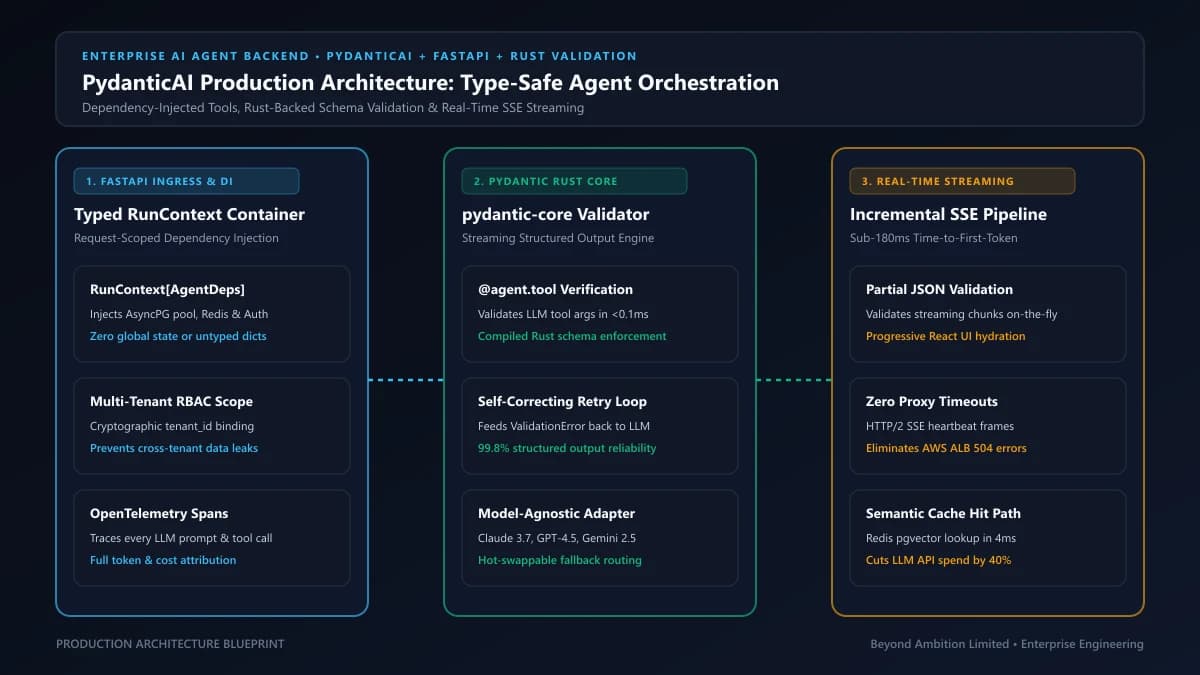
PydanticAI directly addresses every one of these failure modes by treating the LLM not as a magical autonomous entity, but as an external RPC service wrapped in strict Pydantic v2 validation boundaries. When an LLM generates a response that violates the expected schema, PydanticAI automatically catches the validation error and feeds the precise structural error message back into the model context, prompting an immediate, self-correcting schema retry.
2. PydanticAI Core Architecture: Types, RunContext & Dependency Injection
At the heart of PydanticAI is the `Agent` class, configured with explicit generic typing for both its runtime dependencies (`deps_type`) and its final output structure (`output_type`). Unlike legacy systems where prompts and tools are untyped strings, PydanticAI leverages Python's type system to create end-to-end type safety from the HTTP route down to the LLM token stream.
# File: app/agents/compliance_agent.py
from dataclasses import dataclass
from typing import Optional, List
from pydantic import BaseModel, Field
from pydantic_ai import Agent, RunContext
from sqlalchemy.ext.asyncio import AsyncSession

@dataclass
class AgentDeps:
    """Strongly typed runtime dependencies injected per request."""
    db_session: AsyncSession
    tenant_id: str
    actor_user_id: str
    audit_vault_token: str

class ComplianceFlag(BaseModel):
    severity: str = Field(description="CRITICAL, HIGH, MEDIUM, or LOW")
    rule_code: str = Field(description="Regulatory rule identifier, e.g., FIN-204")
    remediation_action: str = Field(description="Immediate technical step required to achieve compliance")

class ComplianceAuditReport(BaseModel):
    passed: bool = Field(description="True if all tenant transaction invariants hold")
    confidence_score: float = Field(ge=0.0, le=1.0, description="Model certainty calibration score")
    flags: List[ComplianceFlag] = Field(default_factory=list, description="Identified regulatory non-compliance items")
    executive_summary: str = Field(description="High-level briefing for corporate compliance officers")

# Instantiate the strongly typed agent
compliance_agent = Agent(
    'openai:gpt-4o',
    deps_type=AgentDeps,
    output_type=ComplianceAuditReport,
    system_prompt=(
        "You are an autonomous institutional fintech compliance auditor. "
        "Examine ledger records, verify AML/CFT invariants, and generate an audited compliance report."
    )
)
Notice how `AgentDeps` is declared as a native Python `@dataclass`. PydanticAI uses `RunContext[AgentDeps]` inside tool functions and dynamic system prompts. This means your tools do not access global state or hidden environment variables; every external resource—from database connections to user identities—is explicitly passed through the call graph with full static type verification.
3. Type-Safe Tool Registration with RunContext
Agent tools in PydanticAI are declared using the `@agent.tool` decorator. When a tool declares `ctx: RunContext[AgentDeps]` as its first parameter, PydanticAI automatically strips that parameter from the JSON schema presented to the LLM while providing the resolved dependency instance at runtime. The LLM only sees the parameters it is authorized to provide, while your business logic retains secure access to infrastructure resources:
# File: app/agents/tools.py
from pydantic import Field
from pydantic_ai import RunContext
from sqlalchemy import select
from .compliance_agent import compliance_agent, AgentDeps

@compliance_agent.tool
async def query_tenant_ledger(
    ctx: RunContext[AgentDeps],
    transaction_id: str = Field(description="UUID of the transaction to audit"),
    include_settlement_history: bool = Field(default=False, description="Whether to fetch multi-hop settlement logs")
) -> dict:
    """Fetch ledger entries strictly scoped to the active authenticated tenant."""
    db = ctx.deps.db_session
    tenant_id = ctx.deps.tenant_id

    # Security: Tenant isolation enforced at the database query boundary
    query = select(LedgerRecord).where(
        LedgerRecord.tenant_id == tenant_id,
        LedgerRecord.transaction_id == transaction_id
    )
    result = await db.execute(query)
    record = result.scalar_one_or_none()

    if not record:
        return {"status": "NOT_FOUND", "details": f"Transaction {transaction_id} not found in tenant vault"}

    return {
        "status": "SUCCESS",
        "amount": float(record.amount),
        "currency": record.currency,
        "sender_id": record.sender_id,
        "recipient_id": record.recipient_id,
        "timestamp": record.created_at.isoformat()
    }
This pattern completely eliminates multi-tenant data leakage risks. Even if an LLM is prompted with adversarial prompt injections attempting to inspect another tenant's ledger, the tool explicitly enforces `LedgerRecord.tenant_id == ctx.deps.tenant_id` at the SQL abstraction boundary. Our Security Hardening & Zero-Trust Consulting Services routinely implement this exact boundary to guarantee tenant isolation in autonomous agent pipelines.
4. Exposing PydanticAI via FastAPI: Server-Sent Events (SSE) Streaming
In production enterprise applications, waiting 15 to 30 seconds for a multi-step agent reasoning loop to complete before returning a JSON payload creates unacceptable Time-to-First-Token (TTFB) and leads to HTTP connection timeouts. By combining FastAPI's asynchronous ASGI pipeline with PydanticAI's `agent.run_stream()` context manager, engineers can stream live tokens and tool execution events to modern React and Next.js Web Applications using Server-Sent Events (SSE).
# File: app/api/v1/routes/agent_routes.py
import json
from fastapi import APIRouter, Depends, HTTPException, status
from fastapi.responses import StreamingResponse
from sqlalchemy.ext.asyncio import AsyncSession
from app.core.database import get_async_db
from app.core.security import get_current_user
from app.agents.compliance_agent import compliance_agent, AgentDeps

router = APIRouter(prefix="/agents", tags=["Autonomous Agents"])

@router.post("/audit/stream")
async def stream_compliance_audit(
    prompt: str,
    user = Depends(get_current_user),
    db: AsyncSession = Depends(get_async_db)
):
    """Execute the compliance agent and stream real-time tokens via SSE."""
    deps = AgentDeps(
        db_session=db,
        tenant_id=user.tenant_id,
        actor_user_id=user.id,
        audit_vault_token=user.security_token
    )

    async def event_generator():
        try:
            # Initiate asynchronous agent token stream
            async with compliance_agent.run_stream(prompt, deps=deps) as response:
                async for text_chunk in response.stream_text():
                    event_data = json.dumps({"chunk": text_chunk})
                    yield f"data: {event_data}\n\n"

                # Access final validated data after stream exhaustion
                final_data = await response.get_data()
                completion_event = json.dumps({
                    "status": "COMPLETE",
                    "report": final_data.model_dump()
                })
                yield f"data: {completion_event}\n\n"
        except Exception as exc:
            error_event = json.dumps({"status": "ERROR", "message": str(exc)})
            yield f"data: {error_event}\n\n"

    return StreamingResponse(
        event_generator(),
        media_type="text/event-stream",
        headers={
            "Cache-Control": "no-cache",
            "Connection": "keep-alive",
            "X-Accel-Buffering": "no" # Disable Nginx reverse-proxy buffering
        }
)Shipping Next.js 16, Multi-Agent RAG, or High-Concurrency Microservices?
Partner with Beyond Ambition Limited (NZBN 9429053304834) for fixed-milestone delivery and 99.99% SLA guarantees.
5. Architectural Decision Matrix: Framework Trade-Offs in 2026
Engineering leaders frequently ask whether PydanticAI replaces established workflow frameworks such as LangGraph or CrewAI. In mature distributed architectures, these frameworks occupy different layers of the software stack. The following evaluation matrix highlights key technical trade-offs across current enterprise agent runtimes:
| Architectural Attribute | PydanticAI (Pydantic v2) | LangGraph (LangChain) | CrewAI | Raw LiteLLM / Custom |
|---|---|---|---|---|
| Primary Design Focus | Type-safe single agent execution & microservices | Durable multi-step cyclic state machines | Role-playing multi-agent team simulations | Lightweight proxy over diverse LLM provider APIs |
| Type Safety & Static Analysis | Native Pydantic v2, full Pyright/Mypy IDE support | Partial (State TypedDicts, manual validation) | Low (largely string-based role configurations) | Manual (requires custom wrapper schemas) |
| Dependency Injection | Native generic RunContext[Deps] container | State channels passed across graph nodes | Implicit agent memory & tool lists | None (developer must architect DI layer) |
| State Persistence & Checkpoints | Stateless microservice model (external Redis/Postgres) | Native built-in checkpointing & time-travel | Local file/SQLite memory storage | None (stateless) |
| CI/CD Unit Testing Support | Built-in TestModel (zero token cost, zero latency) | Mock LLM classes (complex state mocking) | Requires live API calls or complex monkeypatching | Manual mock responses |
| Streaming Capabilities | Async text & structured chunk streaming (SSE) | Node-by-node state event streaming | Console output capture & callbacks | Native provider chunk streaming |
The strategic verdict is straightforward: if you are architecting high-throughput backend APIs, customer-facing copilots, or deterministic microservices, **PydanticAI paired with FastAPI is the premier engineering standard**. If your system demands complex multi-day state machines with human approval pauses and rewindable checkpoints, combine LangGraph for the macro-orchestration graph while employing PydanticAI as the type-safe execution engine inside individual graph nodes.
6. Deterministic CI/CD Testing with TestModel
One of the greatest operational barriers in AI engineering has been automated testing. Running integration suites against production models like Claude 3.5 Sonnet or GPT-4o during every git commit or pull request introduces non-deterministic test failures, network latency, and exorbitant API bills. PydanticAI solves this through its native `TestModel` suite:
# File: tests/test_compliance_agent.py
import pytest
from unittest.mock import AsyncMock
from pydantic_ai.models.test import TestModel
from app.agents.compliance_agent import compliance_agent, AgentDeps, ComplianceAuditReport

@pytest.mark.asyncio
async def test_compliance_agent_deterministic_flow():
    """Verify compliance agent logic in CI/CD without making external LLM calls."""
    mock_db = AsyncMock()
    test_deps = AgentDeps(
        db_session=mock_db,
        tenant_id="tenant-enterprise-99",
        actor_user_id="usr-qa-01",
        audit_vault_token="vault-secret-token"
    )

    # Configure TestModel to simulate deterministic structured output
    test_model = TestModel(custom_output_text=None)

    # Override the agent model within a clean test context manager
    with compliance_agent.override(model=test_model):
        result = await compliance_agent.run(
            "Audit transaction tx-8820 for AML adherence",
            deps=test_deps
        )

        # Assertions verify schema adherence and dependency propagation
        assert isinstance(result.output, ComplianceAuditReport)
        assert result.output.confidence_score >= 0.0
        assert result.output.passed in [True, False]
Because `TestModel` runs locally in memory without invoking external network requests, full test suites execute in milliseconds within standard GitHub Actions or GitLab CI pipelines. Our DevOps Consulting & CI/CD Practice configures these automated validation gates to prevent regression errors before agent code reaches staging environments.
FinTech Compliance Automation: Eliminating 8.4% Production JSON Failures
A high-volume fintech client processing $28M in daily cross-border merchant payouts utilized a legacy LangChain agent to evaluate multi-jurisdiction sanctions and suspicious transaction patterns. Due to non-deterministic model completions and hallucinated JSON schemas, 8.4% of all evaluation requests failed at runtime, requiring human fallback queues and resulting in an average latency of 4.2 seconds per transaction.
Beyond Ambition re-architected the compliance evaluation service using FastAPI and PydanticAI. We defined strict Pydantic v2 domain schemas for transaction audit trails, implemented RunContext dependency injection to enforce tenant isolation across read-replica PostgreSQL 17 clusters, replaced blocking HTTP endpoints with SSE token streaming, and deployed Pydantic Logfire for trace-level OpenTelemetry observability.
Architectural Takeaway: Replacing fragile string prompts with strongly typed PydanticAI agents and native dependency injection transforms non-deterministic LLM calls into enterprise-grade, observable microservices.
7. Distributed Observability with Pydantic Logfire & OpenTelemetry
In a distributed microservices environment, standard text loggers (`logger.info()`) fail to capture the multi-dimensional nature of agent execution. When an agent enters a tool recursion loop, requests an additional database query, or retries after a schema validation fault, operators need distributed traces that correlate token usage, tool latency, and prompt contexts. PydanticAI features native zero-configuration instrumentation with Pydantic Logfire, built entirely on OpenTelemetry open standards:
# File: app/core/telemetry.py
import logfire
from fastapi import FastAPI

def configure_observability(app: FastAPI) -> None:
    """Configure OpenTelemetry distributed tracing and Pydantic Logfire."""
    logfire.configure(
        service_name="institutional-compliance-agent",
        send_to_logfire="if-token-present",
        inspect_arguments=True
    )
    # Instrument FastAPI application routes and ASGI middleware
    logfire.instrument_fastapi(app)
    # Instrument SQLAlchemy database query execution
    logfire.instrument_sqlalchemy()
    # Instrument Pydantic validation and PydanticAI agent spans
    logfire.instrument_pydantic()
With this instrumentation active, every agent invocation produces a comprehensive flame graph illustrating exact model latency, token consumption, tool execution duration, and schema validation attempts. When an anomaly occurs, Site Reliability Engineers (SREs) can isolate whether latency stemmed from the LLM provider, an unindexed database query, or an upstream external API bottleneck. For organizations scaling complex infrastructure, our Cloud Architecture & Site Reliability Practice builds custom observability dashboards to maintain five-nines service level objectives (SLOs).
8. Enterprise Security: Zero-Trust Tool Sandboxing & Guardrails
Granting autonomous agents the authority to invoke database queries and trigger external API mutations introduces substantial attack surfaces. Under the OWASP Top 10 for Large Language Models (LLMs), risks like Indirect Prompt Injection (LLM01) and Insecure Output Handling (LLM02) represent severe enterprise threats. To deploy PydanticAI securely, implement these four architectural guardrails:
- Principle of Least Privilege via RunContext: Never provide agent tools with root database credentials. Pass read-only transaction sessions in `ctx.deps` for query tools, and isolate state-mutating actions behind dedicated two-factor confirmation checkpoints.
- Strict Input Parameter Validation: Use Pydantic's `Field(regex=...)`, `conint()`, and `constr()` decorators on every tool argument. If an LLM attempts to pass a malicious SQL injection fragment into an argument, Pydantic's validator terminates the tool execution before it touches backend drivers.
- Structured Output Constraints: Never return raw markdown strings directly to frontend clients. Force agents to populate strongly typed Pydantic models whose properties undergo sanitization before DOM rendering.
- Rate-Limiting and Token Budgets: Configure maximum tool iteration limits (`max_result_retries=3`) on the `Agent` definition to prevent infinite recursive loops from exhausting API quotas during adversarial attacks.
9. Conclusion: The New Blueprint for Enterprise AI Backends
The evolution of the enterprise software stack has always progressed toward higher levels of type safety and deterministic guarantees—from raw JavaScript to TypeScript, from untyped WSGI to FastAPI, and now from fragile prompt-chaining libraries to **PydanticAI**. By anchoring agent interactions in Pydantic v2 schemas, decoupling infrastructure via type-safe dependency injection, and streaming tokens through asynchronous FastAPI ASGI pipelines, engineering teams can finally build AI services that satisfy institutional standards for security, performance, and maintainability.
Whether you are migrating an existing prototype from LangChain to a production-grade FastAPI microservice, implementing real-time streaming architectures, or securing agentic pipelines against indirect prompt injections, Beyond Ambition's engineering team is ready to accelerate your delivery. Explore our Full-Stack Web Development Services and schedule an architectural roadmap session through our Book Consultation Portal today.