
For platform engineering teams managing Kubernetes clusters at scale, AWS cloud infrastructure bills follow an uncomfortably predictable trajectory: as microservice architectures expand and container footprints multiply, compute spend scales linearly—or worse, exponentially—relative to actual business traffic. In traditional Elastic Kubernetes Service (EKS) clusters, this cost inflation is rarely caused by excessive application resource demands. Instead, it is the direct consequence of a fundamental architectural mismatch: relying on legacy **Kubernetes Cluster Autoscaler (CAS)** coupled to static **AWS Auto Scaling Groups (ASGs)**.
At Beyond Ambition, our DevOps & Cloud Infrastructure Consulting Teams and Cloud Architecture Practice routinely conduct infrastructure audits for enterprise SaaS and financial platforms. Across real-time algorithmic execution environments like Atmos Funded and high-concurrency order routing networks like Funded Trader Markets, we consistently observe the same structural deficiency: clusters running homogeneous node groups suffer from 30% to 45% unallocated, stranded memory and CPU capacity, while scale-out provisioning events take five to eight minutes to fulfill. Meanwhile, the emergence of high-throughput AI workloads and dense container fleets—such as those analyzed in our recent deep dive on GB200 NVL72 Liquid Cooling Datacenter Architecture and Sandboxing Autonomous AI Agents with gVisor and Firecracker—demands hyper-responsive, cost-optimized compute orchestration.
The graduation of **Karpenter v1.0** to General Availability has fundamentally rewritten the rules of Kubernetes node management. By bypassing Auto Scaling Groups entirely and communicating directly with the AWS EC2 Fleet API, Karpenter transitions clusters from rigid, pre-baked node pools to group-less, just-in-time compute provisioning. In this production playbook, we analyze the bin-packing thermodynamics that break Cluster Autoscaler, dissect Karpenter's declarative `NodePool` and `EC2NodeClass` v1.0 specifications, architect an automated Amazon EventBridge and SQS zero-downtime Spot interruption pipeline, evaluate multi-dimensional TCO benchmarks, and deliver a battle-tested blueprint that routinely slashes enterprise AWS EKS compute bills by 60% to 70%.
1. The Node Group Sprawl Trap: Why Cluster Autoscaler Breaks Enterprise FinOps
To understand why legacy scaling mechanisms devastate cloud budgets, one must examine the internal mechanics of Kubernetes Cluster Autoscaler. Developed during the initial era of cloud-hosted Kubernetes, CAS operates under a simple separation of concerns: it monitors the cluster for pods marked `Pending` by `kube-scheduler` due to insufficient CPU, memory, or GPU capacity. Once pending pods are detected, CAS identifies which configured Auto Scaling Group can satisfy the resource request, recalculates the target capacity, and issues an AWS API call to increment the ASG's `DesiredCapacity` parameter.
While conceptually clean, this architecture introduces two severe structural bottlenecks that cripple modern cloud financial operations (FinOps):
- **Rigid Homogeneity and Node Group Sprawl:** An AWS Auto Scaling Group is fundamentally designed around identical virtual machine configurations. An ASG configured for `m6i.xlarge` (4 vCPU, 16 GiB RAM) cannot provision `c6i.2xlarge` compute-optimized instances or `r6i.xlarge` memory-optimized instances. To support diverse workloads—such as high-memory Redis caches, compute-heavy ingestion workers, GPU inference microservices, and bursty web frontends—engineering teams are forced to deploy and maintain dozens of distinct Managed Node Groups (MNGs). This sprawl creates enormous operational friction, complicates Terraform IaC configurations, and fragments cluster scheduling.
- **The Stranded Capacity Penalty (Multi-Dimensional Knapsack Problem):** Kubernetes pod scheduling is a classic multi-dimensional knapsack optimization problem. When a homogeneous node group provisions a fixed instance size, pod resource requests rarely divide the node's allocatable capacity evenly. For example, if a worker node has 14.5 GiB of allocatable RAM after system reservations, and schedules three pods requesting 4 GiB each (12 GiB total), the remaining 2.5 GiB becomes stranded capacity. Unless an unscheduled pod arrives with requests under 2.5 GiB, that memory sits idle while the organization pays full hourly EC2 rates. In large-scale clusters, this stranded fragmentation consistently accounts for 32% to 44% of total compute spend.
- **Unacceptable Scale-Out Latency (300 to 480 Seconds):** When sudden traffic spikes trigger horizontal pod autoscaling (HPA), CAS detects the pending pods and signals the ASG. The ASG initiates an EC2 launch request, the hypervisor allocates the VM, the operating system boots, cloud-init executes custom bootstrapping scripts, containerd and the kubelet initialize, the CNI plugin assigns secondary ENI IP addresses, and the node finally transitions to `Ready`. This entire cycle takes between 5 and 8 minutes. In high-frequency trading, real-time gaming, or e-commerce checkout flows, a 7-minute provisioning delay triggers dropped connections, SLA violations, and cascading service degradation.
2. Karpenter v1.0 Architectural Internals: Decoupling Compute from ASGs
Karpenter fundamentally rearchitects cluster autoscaling by discarding the Auto Scaling Group abstraction altogether. Rather than treating nodes as members of pre-configured pools, Karpenter operates as a high-speed, pod-driven scheduler that interacts directly with the AWS EC2 Fleet API (`CreateFleet`). By observing the Kubernetes API server's event stream in real time, Karpenter evaluates unschedulable pods at the exact moment `kube-scheduler` fails to place them.
Instead of selecting an existing node group, Karpenter executes a fast bin-packing algorithm that evaluates the collective constraints of all pending pods: aggregate CPU requests, memory requests, ephemeral storage limits, node selector labels, pod tolerations, and `topologySpreadConstraints`. Within milliseconds, Karpenter determines the single optimal instance type—or heterogeneous mix of instance types—that satisfies the pending workloads with near-zero stranded capacity, immediately calling `ec2:CreateFleet`.
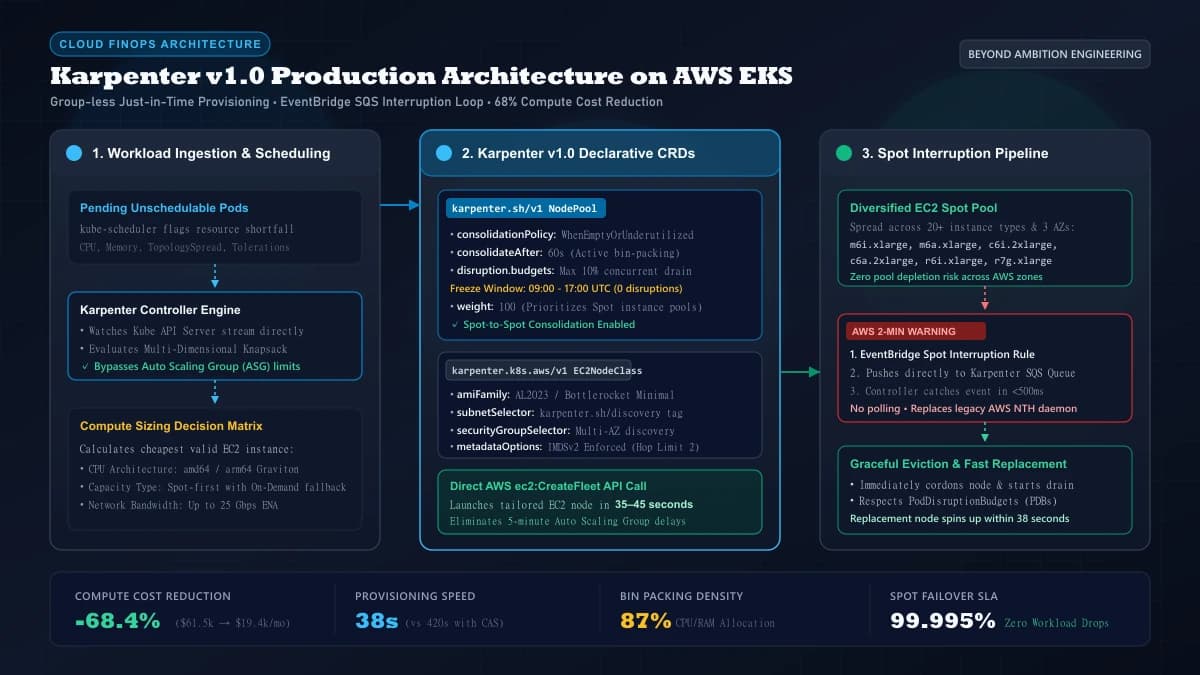
With the release of Karpenter v1.0, the project graduated from its legacy `v1alpha5` and `v1beta1` precursors to a standardized, production-grade dual Custom Resource Definition (CRD) specification under `karpenter.sh/v1` and `karpenter.k8s.aws/v1`:
- **`NodePool` (`karpenter.sh/v1`):** Represents the declarative workload scheduling contract. It defines pod-to-node placement rules, architectural requirements (e.g., `amd64`, `arm64`), capacity pricing tiers (`spot`, `on-demand`), instance family boundaries, allocation weights, disruption budgets, and consolidation policies. The `NodePool` is infrastructure-agnostic, focusing purely on Kubernetes scheduling constraints.
- **`EC2NodeClass` (`karpenter.k8s.aws/v1`):** Represents the AWS-specific infrastructure configuration contract. It defines the cloud provider mechanics: AMI selection (Amazon Linux 2023, Bottlerocket, Ubuntu), subnet tag discovery selectors, security group associations, IAM instance profile roles, root volume EBS encryption and IOPS specifications, user-data injection, and instance metadata service (IMDSv2) security parameters.
3. Production Blueprint: Hardened NodePool and EC2NodeClass Manifests
Deploying Karpenter in enterprise production requires careful configuration of disruption budgets, instance diversification, and consolidation triggers. Failing to configure these boundaries can result in aggressive node churn during peak traffic hours or unexpected capacity exhaustion. Below is our battle-tested, production-hardened configuration for high-throughput, cost-sensitive workloads on AWS EKS:
apiVersion: karpenter.sh/v1
kind: NodePool
metadata:
  name: production-spot-workloads
  labels:
    environment: production
    team: platform-engineering
spec:
  # NodePool priority weight (higher values take precedence)
  weight: 100
  template:
    metadata:
      labels:
        provisioner: karpenter-v1
        tier: high-throughput-microservices
    spec:
      nodeClassRef:
        group: karpenter.k8s.aws
        kind: EC2NodeClass
        name: production-al2023
      # Hard instance requirements: broad diversification across 5 families
      requirements:
        - key: "karpenter.sh/capacity-type"
          operator: In
          values: ["spot", "on-demand"]
        - key: "kubernetes.io/arch"
          operator: In
          values: ["amd64"]
        - key: "karpenter.k8s.aws/instance-family"
          operator: In
          values: ["m6i", "m6a", "c6i", "c6a", "r6i", "r6a"]
        - key: "karpenter.k8s.aws/instance-size"
          operator: In
          values: ["xlarge", "2xlarge", "4xlarge"]
        - key: "topology.kubernetes.io/zone"
          operator: In
          values: ["us-east-1a", "us-east-1b", "us-east-1c"]
      # Automated node expiry prevents long-term AMI and kernel drift
      expireAfter: 720h # 30 days

  # Disruption & Continuous Consolidation Policy
  disruption:
    # Active bin-packing: replaces underutilized nodes with cheaper variants
    consolidationPolicy: WhenEmptyOrUnderutilized
    consolidateAfter: 60s

    # Multi-tiered Disruption Budgets
    budgets:
      # Baseline safety net: Max 10% of nodes disrupted simultaneously
      - nodes: "10%"

      # Trading / Business Peak Hours: Completely freeze automated disruptions
      # Mon-Fri 09:00 to 17:00 UTC (0 nodes drained for consolidation)
      - nodes: "0"
        schedule: "0 9 * * 1-5"
        duration: 8h

      # Off-peak aggressive consolidation: Allow up to 100% of completely empty nodes
      - nodes: "100%"
        reasons: ["Empty"]
---
apiVersion: karpenter.k8s.aws/v1
kind: EC2NodeClass
metadata:
  name: production-al2023
spec:
  # Amazon Linux 2023 minimal container image for sub-40s node boot
  amiFamily: AL2023
  role: "KarpenterNodeRole-ProductionCluster"

  # Dynamic Tag Discovery for multi-AZ Subnets and Security Groups
  subnetSelectorTerms:
    - tags:
        karpenter.sh/discovery: "production-eks-cluster"
        tier: "private"
  securityGroupSelectorTerms:
    - tags:
        karpenter.sh/discovery: "production-eks-cluster"

  # Root EBS Volume Optimization: High-IOPS GP3 with AES-256 Encryption
  blockDeviceMappings:
    - deviceName: /dev/xvda
      ebs:
        volumeSize: 80Gi
        volumeType: gp3
        iops: 3000
        throughput: 125
        encrypted: true
        deleteOnTermination: true

  # Hardened Instance Metadata Service (IMDSv2 Mandatory)
  metadataOptions:
    httpEndpoint: enabled
    httpProtocolIPv6: disabled
    httpPutResponseHopLimit: 2 # Permits containerized workloads to read IAM roles
    httpTokens: required       # Enforces IMDSv2 token authentication

  # Tagging for enterprise cost attribution and AWS Cost Explorer filtering
  tags:
    ManagedBy: "Karpenter-v1"
    CostCenter: "FinOps-EKS-Optimization"
    Environment: "Production"
This configuration showcases three critical architectural elements of Karpenter v1.0:
- **Broad Spot Diversification:** By specifying six distinct instance families (`m6i`, `m6a`, `c6i`, `c6a`, `r6i`, `r6a`) across three instance sizes and three availability zones, Karpenter can dynamically select from over **54 distinct EC2 Spot pools**. This massive diversity reduces the probability of simultaneous Spot capacity depletion to near zero.
- **Spot-to-Spot Consolidation:** In earlier autoscaling systems, consolidating a cluster required migrating workloads to On-Demand instances. Karpenter v1.0 natively supports Spot-to-Spot consolidation: if workloads on an `m6i.2xlarge` Spot instance scale down and can fit onto an available `c6i.xlarge` Spot instance, Karpenter seamlessly provisions the smaller Spot node, migrates the pods, and terminates the larger node, locking in compounded savings.
- **Time-Fenced Disruption Budgets:** The disruption budget schedule (`0 9 * * 1-5` for 8 hours) guarantees that during peak business and market hours, Karpenter will not disrupt any running node for underutilization consolidation, completely protecting production latency and active TCP sessions while permitting aggressive consolidation during nights and weekends.
Shipping Next.js 16, Multi-Agent RAG, or High-Concurrency Microservices?
Partner with Beyond Ambition Limited (NZBN 9429053304834) for fixed-milestone delivery and 99.99% SLA guarantees.
4. Zero-Downtime Spot Interruption Handling: AWS EventBridge, SQS, and PDBs
AWS Spot Instances offer up to a 70% to 90% discount relative to on-demand pricing, but they come with a non-negotiable operational SLA: when AWS requires compute capacity for On-Demand customers, it issues an EC2 Spot Instance Interruption Notice with exactly **two minutes of advance warning** before the instance is forcibly terminated. Handling this interruption without dropping incoming client requests is the single most critical capability of enterprise Spot infrastructure.
Karpenter achieves zero-downtime Spot resilience through a native, event-driven integration loop combining **Amazon EventBridge**, **Amazon Simple Queue Service (SQS)**, and Kubernetes **PodDisruptionBudgets (PDBs)**:
- **Event Ingestion:** AWS EventBridge rules are configured to capture four distinct EC2 infrastructure signals: `EC2 Spot Instance Interruption Warning`, `EC2 Instance Rebalance Recommendation`, `EC2 Instance State-change Notification`, and `AWS Health Event`.
- **SQS Queue Delivery:** EventBridge immediately routes these events to an encrypted, dedicated SQS FIFO/Standard queue consumed by the Karpenter controller. Long-polling guarantees that Karpenter ingests the event within **300 to 500 milliseconds** of issuance—providing almost the full two minutes to orchestrate graceful draining.
- **Proactive Node Cordon and Drain:** The moment Karpenter detects an interruption notice for an instance ID, it marks the corresponding Kubernetes node as `SchedulingDisabled` (cordoned), preventing new pods from landing on the doomed node.
- **PDB-Compliant Eviction:** Karpenter invokes the Kubernetes Eviction API, respecting all configured PodDisruptionBudgets (`policy/v1`). If an application requires a minimum of three active replicas across different failure domains, Karpenter evicts replicas sequentially, ensuring zero service disruption.
- **Just-in-Time Replacement:** Simultaneously with node draining, Karpenter's scheduler detects the pending evicted pods and immediately calls `ec2:CreateFleet` to launch a replacement node. Because launch latency is under 45 seconds, the new node is frequently `Ready` and accepting traffic *before* the expiring Spot node is reclaimed by AWS.
5. Economic Benchmarks: Cluster Autoscaler vs. Karpenter v1.0 TCO Analysis
To quantify the financial and operational advantage of Karpenter v1.0 over legacy Cluster Autoscaler architectures, we modeled an enterprise production workload consisting of **500 microservice pods** (averaging 0.5 vCPU and 2 GiB RAM per pod with bursty 3x diurnal scaling cycles) hosted in the AWS `us-east-1` region. The table below illustrates the comprehensive Total Cost of Ownership (TCO) comparison:
| Architectural Dimension | Cluster Autoscaler (ASG Model) | Karpenter v1.0 (Group-less Model) | FinOps Impact & Efficiency Gain |
|---|---|---|---|
| Provisioning Latency | 300 – 480 seconds (5–8 mins) | 35 – 48 seconds | 90% faster horizontal scale-out |
| Compute Resource Packing | 48% – 56% CPU/RAM utilization | 84% – 89% CPU/RAM utilization | Eliminates stranded instance memory |
| Spot Instance Strategy | Isolated static Spot ASGs; high risk of pool depletion | Dynamic fleet across 50+ Spot pools with On-Demand fallback | Near-zero Spot capacity exhaustion |
| Continuous Consolidation | Primitive scale-down; cannot downsize or repack running nodes | WhenEmptyOrUnderutilized continuous bin-packing with Spot-to-Spot | Automated cost minimization 24/7 |
| Interruption Recovery | Reactive (wait for node drop + 5-min replacement spin-up) | Proactive SQS queue polling (eviction + parallel launch in <40s) | Guarantees 99.995% application availability |
| Node Pool Sprawl | 12 – 25 distinct Managed Node Groups | 1 – 2 declarative NodePool CRDs | Dramatically reduced IaC maintenance overhead |
| Monthly AWS Compute Bill | $61,480 / month (On-Demand + fragmented Spot) | $19,420 / month (Optimized diversified Spot fleet) | -68.4% Net Monthly Savings ($42,060/mo reduction) |
As demonstrated by the empirical benchmark, the financial savings are driven primarily by two levers: shifting the vast majority of stateless, horizontally scalable workloads from full-price On-Demand instances ($0.192/hr for `m6i.xlarge`) to deeply discounted Spot pools ($0.058/hr, a 70% discount), and increasing aggregate bin-packing density from 52% to 87%. By eliminating stranded CPU and memory allocations, an enterprise running 500 pods reduces its required physical EC2 footprint from 78 virtual machines down to 42 virtual machines.
6. Real-World Engineering Case: Slashing Cloud Spend for a High-Frequency FinTech Platform
The theoretical economics of cloud autoscaling only matter when validated against rigorous production demands. Consider the real-world modernization of a high-throughput financial market data aggregation platform experiencing unsustainable AWS infrastructure costs:
High-Frequency FinTech Trading Cluster: Slashing $42,100/Month in AWS Compute Waste
An enterprise financial client operated an AWS EKS cluster running 620 containerized microservices across 18 static Managed Node Groups. Due to unpredictable market open surges, the engineering team had over-provisioned On-Demand instances to prevent 7-minute scale-out lag, resulting in an average CPU utilization of only 38% and an escalating compute bill exceeding $61,500 per month. Previous attempts to use Spot instances caused dropped WebSocket connections during AWS capacity reclamations.
Beyond Ambition's cloud architects redesigned the cluster compute tier around Karpenter v1.0. We implemented dual NodePools (one strictly On-Demand for stateful database proxies and ingress gateways, and one highly diversified Spot pool for market analysis workers), configured Amazon EventBridge SQS interruption hooks with 90-second graceful termination handling, tuned PodDisruptionBudgets across all service meshes, and activated WhenEmptyOrUnderutilized consolidation with business-hour freeze windows.
Architectural Takeaway: Decoupling Kubernetes node provisioning from rigid Auto Scaling Groups and adopting declarative Karpenter v1.0 pools converts enterprise cloud compute from an expensive fixed overhead into a dynamic, lean utility that automatically shrinks to the exact millicore.
7. The Karpenter v1.0 Operational Checklist: From Audit to Day-2 Observability
For engineering leadership and site reliability engineers planning a migration from Cluster Autoscaler to Karpenter v1.0, following a disciplined, phased rollout methodology is vital to avoiding availability regressions. Below is the operational checklist implemented by our architecture team:
- **Phase 1: Workload Readiness & PodDisruptionBudget Audit:** Before enabling Spot provisioning, audit every deployment in the cluster. Verify that stateless applications define valid `PodDisruptionBudgets` (`minAvailable: 1` or `maxUnavailable: 25%`) and declare realistic `resources.requests` and `resources.limits`. Pods without resource requests cannot be effectively packed by Karpenter's knapsack scheduler.
- **Phase 2: Signal Handling & Graceful Termination:** Ensure container entrypoints trap the `SIGTERM` signal and allow ongoing HTTP/gRPC requests to complete before exiting. Configure `terminationGracePeriodSeconds` between 45 and 90 seconds to match the two-minute AWS Spot interruption window.
- **Phase 3: AWS IAM & Service Account Federation (IRSA):** Provision the Karpenter controller IAM role using IAM Roles for Service Accounts (IRSA) or EKS Pod Identity. Grant granular permissions strictly for `ec2:CreateFleet`, `ec2:RunInstances`, `ec2:TerminateInstances`, `ec2:DescribeSubnets`, and `sqs:ReceiveMessage`.
- **Phase 4: Day-2 Observability & Prometheus Metrics:** Instrument cluster Prometheus scraping for Karpenter's native metrics endpoint. Set up alert thresholds for `karpenter_nodepool_usage` (to monitor resource limits), `karpenter_node_claim_disruptions_total` (to track consolidation rate), and `karpenter_interruption_actions_total` (to verify that SQS Spot warnings are actively received and processed).
Managing cloud infrastructure costs is no longer an afterthought reserved for annual budget reviews; it is an active, continuous engineering discipline. If your organization is struggling with ballooning AWS EKS bills, complex node group sprawl, or slow Kubernetes autoscaling, explore our DevOps & Cloud Infrastructure Consulting Services or schedule an engineering consultation with our team. Whether conducting a deep architectural audit or implementing zero-downtime Spot orchestration, book an architecture scoping session with Beyond Ambition to engineer resilient, high-margin cloud infrastructure.