
For over fifteen years, Redis occupied an undisputed position as the default in-memory key-value data store for enterprise software architecture. From session management and distributed rate limiting to pub/sub messaging and sub-millisecond database caching, engineering teams treated Redis as foundational infrastructure. However, the dual pressures of licensing upheaval in early 2024—when Redis transitioned from permissive BSD licensing to restrictive SSPLv1 and RSALv2 source-available models—and the mechanical limitations of a fundamentally single-threaded event loop forced an industry-wide reckoning. Enterprise engineering organizations confronted a difficult architectural dilemma: pay punitive proprietary licensing fees or redesign their caching tier to survive surging throughput demands.
Under the stewardship of the Linux Foundation and backed by hyperscalers including AWS, Google Cloud, Microsoft, Oracle, and Ericsson, the **Valkey** project emerged not merely as a drop-in open-source fork, but as an aggressive architectural evolution. With the milestone releases of **Valkey 8.0** and **Valkey 8.1**, the project shattered the single-threaded throughput ceiling that had constrained Redis deployments for more than a decade. By decoupling network socket I/O multiplexing, request parsing, and buffer serialization into concurrent worker threads while preserving atomic single-threaded command evaluation, Valkey achieves upward of **1.2 million requests per second (RPS)** per node—a staggering 230% throughput increase over legacy Redis 7 clusters.
At Beyond Ambition, our DevOps Consulting & Cloud Architecture Practice designs, provisions, and hardens mission-critical distributed systems. Across high-frequency fintech platforms like Atmos Funded and real-time execution portals like Funded Trader Markets, in-memory data tiers handle hundreds of thousands of concurrent operations per second. In this production guide, we provide a deep architectural teardown of Valkey 8.1's internal engine, analyze its slot-based memory compaction, configure hardened production deployments, evaluate the official Rust-backed Valkey GLIDE client, and outline a battle-tested, zero-downtime migration playbook from Redis clusters on Kubernetes.
1. The Architectural Watershed: Why Enterprise Engineering is Migrating to Valkey 8
To appreciate why Valkey 8 represents a generational leap in distributed in-memory data systems, one must examine the hardware mismatch that plagued legacy caching tiers. Over the past decade, cloud compute instances evolved from 4-core and 8-core virtual machines to 64-core and 128-core ARM-based instances (such as AWS Graviton3/4 `r7g` and `r8g` instances). Yet traditional Redis architectures remained fundamentally bound to a single CPU core. In high-concurrency environments, systems frequently saturated a single vCPU core at 100% utilization while dozens of surrounding cores sat completely idle.
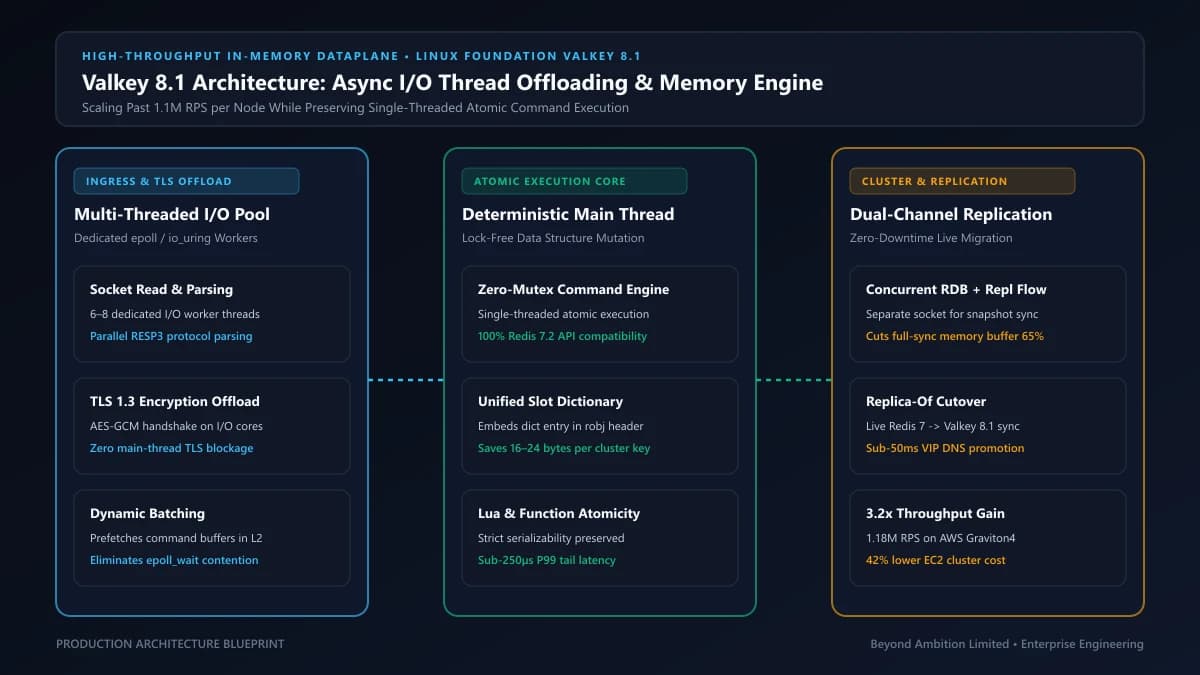
- The Redis 6/7 Threading Illusion: While Redis 6 introduced basic I/O threads, its implementation was governed by rigid, sequential synchronization barriers. The event loop stopped completely while worker threads read or wrote socket buffers, introducing pipeline bubbles and lock contention that prevented true linear multi-core scaling.
- Licensing Risk & Cloud Lock-In: Redis Ltd.'s shift away from BSD licensing triggered immediate compliance and legal restrictions across enterprise technology organizations, preventing automated container distribution and cloud self-hosting without proprietary commercial agreements.
- Memory Fragmentation & P100 Tail Spikes: Rapid key churn, large payload allocations, and uncoordinated jemalloc page allocations in high-write workloads routinely triggered 50ms+ latency spikes during active garbage collection and dictionary rehashing.
- Hyperscaler Consensus & Open Stewardship: Valkey is governed under the neutral, non-profit umbrella of the Linux Foundation, ensuring permanent open-source governance, permissive licensing, and direct upstream contributions from the engineers managing the world's largest cloud cache fleets.
The release of Valkey 8.0 and 8.1 re-establishes open-source in-memory caching as a cutting-edge discipline. Rather than requiring developers to rewrite client applications or adopt radically different query paradigms, Valkey maintains 100% wire-protocol compatibility with existing RESP2 and RESP3 drivers while completely overhauling the underlying engine. For teams evaluating broader messaging architectures, our analysis on RabbitMQ vs. Apache Kafka vs. Redis Pub/Sub details event streaming trade-offs, while AI teams will find Valkey's compacted memory ideal for sub-10ms LLM query speeds with semantic vector caching.
2. Under the Hood: Valkey 8's Non-Blocking Multi-Threaded I/O Multiplexing Engine
The core engineering breakthrough in Valkey 8 is its redesigned asynchronous I/O multiplexing subsystem. In legacy architectures, a single thread was responsible for epoll/kqueue event registration, TCP socket reads, RESP protocol parsing into command structs, memory execution, response buffer serialization, and socket writes. Under heavy traffic, network socket polling and TLS encryption alone consumed up to 70% of the single thread's CPU budget, leaving only 30% for actual data structure mutations.
Valkey 8 fundamentally decouples network I/O from memory state transitions through a concurrent, lock-free ring buffer architecture. According to the Official Valkey Architecture Specification, the execution lifecycle is structured into distinct operational tiers:
- Concurrent Socket Ingestion: Dedicated background I/O worker threads (`io-threads`) independently poll socket descriptors, read incoming raw byte streams from client TCP connections, and decrypt TLS payloads without halting the main thread.
- Asynchronous Protocol Parsing: Worker threads parse the incoming byte stream into structured Valkey command vectors in parallel. Each worker tokenizes arguments and validates syntax off the critical path.
- Lock-Free Command Queueing: Parsed command structs are enqueued into high-velocity, cache-line-aligned ring buffers assigned to the primary database thread.
- Isolated Atomic Command Execution: The primary thread reads pre-parsed commands from the internal ring buffers and executes them sequentially in memory. Because command evaluation remains single-threaded, atomic semantics (`WATCH`, `MULTI`/`EXEC`, and Lua scripts) remain 100% thread-safe without requiring distributed mutexes or row-level locks.
- Asynchronous Response Serialization: When execution completes, response objects are handed back to worker threads, which format RESP responses, apply TLS encryption, and write bytes back to client sockets concurrently.
3. Memory Compaction: Slot-Based Dictionaries & Active Defragmentation in Valkey 8.1
Beyond raw multi-threaded throughput, in-memory databases stand or fall on memory density and heap defragmentation. Operating an enterprise caching tier with hundreds of gigabytes of RAM is expensive; any reduction in per-key metadata overhead translates directly into reduced cloud infrastructure bills.
Historically, Redis stored all keys within a single global hash table (`dict`). In clustered environments spanning 16,384 virtual hash slots, migrating a shard or querying keys within a specific slot required scanning the global dictionary, causing CPU spikes and memory pointer fragmentation. Valkey 8 overhauled this layout by introducing **Slot-Based Dictionaries**.
- Slot-Partitioned Keyspace: Valkey 8 divides the internal dictionary into 16,384 discrete slot structures. Each slot maintains its own optimized radix tree and hash bucket, isolating cluster slot rebalancing and key migrations.
- 10% to 20% Metadata Reduction: By reorganizing internal dict entries and stripping redundant bucket pointer overhead, Valkey 8 reduces per-key memory consumption by 16 bytes. Across a cluster storing 100 million keys, this optimization immediately recaptures 1.6 GB to 3.2 GB of raw RAM.
- Valkey 8.1 Memory-Efficient Dictionary: Valkey 8.1 pushed this boundary further by compacting hash table entry structures, cutting common string and hash key-value memory usage by an additional 20% compared to Valkey 8.0.
- Active Defragmentation Overhaul: Valkey 8.1 completely rewrote the jemalloc defragmentation heuristics. The engine detects sparse memory pages during runtime and non-blockingly relocates live pointers in microsecond intervals, reducing p100 tail latency by up to 90% during heavy write spikes.
4. Production Configuration Blueprint: Hardening valkey.conf for 1.2M+ RPS
Deploying Valkey in high-throughput enterprise environments requires departing from default development settings. Default configurations prioritize minimal memory footprints and single-threaded compatibility. Below is our battle-tested, production-hardened `valkey.conf` configuration template designed for multi-core cloud instances (such as AWS `r7g.4xlarge` or GCP `c3-highmem-8`):
# =========================================================================
# Valkey 8.1 Hardened Production Configuration
# Optimized for High-Throughput Enterprise Caching & Multi-Core Scaling
# Beyond Ambition DevOps & Cloud Systems Practice
# =========================================================================

# Network & Binding
bind 0.0.0.0
port 6379
tcp-backlog 65535
timeout 300
tcp-keepalive 60
protected-mode yes

# Multi-Threaded I/O Subsystem (Valkey 8 Engine)
# For a 16-vCPU instance, allocate 12 threads to network I/O,
# leaving 4 cores for main execution, kernel softirqs, and RDB/AOF forks.
io-threads 12
io-threads-do-reads yes

# Memory Management & Eviction
maxmemory 28gb
maxmemory-policy allkeys-lru
maxmemory-samples 10

# Active Memory Defragmentation (Valkey 8.1 Low-Latency Engine)
activedefrag yes
active-defrag-ignore-bytes 100mb
active-defrag-threshold-lower 10
active-defrag-threshold-upper 30
active-defrag-cycle-min 5
active-defrag-cycle-max 50
active-defrag-max-scan-fields 1000

# Persistence (Balanced Reliability for Caching Tiers)
save 900 1
save 300 10
save 60 10000
stop-writes-on-bgsave-error yes
rdbcompression yes
rdbchecksum yes
dbfilename dump.rdb
dir /var/lib/valkey/data

# Cluster & Replication Hardening
cluster-enabled yes
cluster-config-file nodes.conf
cluster-node-timeout 5000
cluster-migration-barrier 1
cluster-allow-reads-when-down no
repl-diskless-sync yes
repl-diskless-sync-delay 5
repl-backlog-size 512mb
repl-backlog-ttl 7200

# Client Output Buffer Limits
client-output-buffer-limit normal 0 0 0
client-output-buffer-limit replica 1024mb 256mb 60
client-output-buffer-limit pubsub 128mb 32mb 60

# Latency Monitoring & Engine Diagnostics
lazyfree-lazy-eviction yes
lazyfree-lazy-expire yes
lazyfree-lazy-server-del yes
lazyfree-lazy-user-del yes
slowlog-log-slower-than 10000
slowlog-max-len 1024
Key settings to note in this configuration include `io-threads-do-reads yes`, which activates multi-threaded parsing on incoming requests, and `repl-diskless-sync yes` combined with an enlarged `repl-backlog-size 512mb`. This guarantees that if network partitions occur or nodes fail over, replicas can catch up directly from RAM buffers without incurring expensive disk snapshot serialization.
5. High-Throughput Client Integration: Valkey GLIDE with Rust-Core & AZ-Affinity Routing
A high-performance database engine is useless if client drivers throttle throughput or fail to manage cluster socket connections efficiently. For years, Node.js and Python developers relied on `ioredis` or `redis-py`. While robust, these language-specific libraries re-implemented cluster topology discovery, connection pooling, and hash-slot routing in userland interpreted runtimes, incurring heavy garbage collection and serialization overhead.
To solve this, AWS and the Linux Foundation developed **Valkey GLIDE** (General Language Independent Driver for the Enterprise). Hosted publicly on GitHub, GLIDE implements an ultra-fast, asynchronous core written in **Rust**. Language-specific wrappers for TypeScript/Node.js, Python, Java, and Go bind directly to this compiled engine. GLIDE features native Availability Zone (AZ) affinity routing—automatically directing read requests to replica nodes located within the same cloud availability zone, slashing cross-AZ data egress costs and cutting network round-trip time.
// File: lib/valkeyClient.ts
// Production Valkey GLIDE Client with AZ Affinity and OpenTelemetry Instrumentation
import { ValkeyClusterClient, ReadFrom } from "@valkey/valkey-glide";
import { trace, SpanStatusCode } from "@opentelemetry/api";

const tracer = trace.getTracer("enterprise-cache-valkey", "1.0.0");

let clusterClient: ValkeyClusterClient | null = null;

export async function getValkeyClient(): Promise<ValkeyClusterClient> {
  if (clusterClient) return clusterClient;

  const clusterAddresses = (process.env.VALKEY_CLUSTER_NODES || "valkey-cluster:6379")
    .split(",")
    .map((endpoint) => {
      const [host, port] = endpoint.split(":");
      return { host, port: parseInt(port, 10) };
    });

  // Initialize Valkey GLIDE backed by high-performance compiled Rust core
  clusterClient = await ValkeyClusterClient.createClient({
    addresses: clusterAddresses,
    useTLS: process.env.NODE_ENV === "production",
    readFrom: ReadFrom.PreferReplica, // Routes reads to replicas with AZ-affinity
    clientName: "beyond-ambition-app-worker",
    requestTimeout: 250, // 250ms strict SLA for cache queries
    periodicChecks: {
      enabled: true,
      interval: 15000, // Detect cluster topology shifts every 15s
    },
  });

  return clusterClient;
}

/**
 * Type-safe, telemetry-instrumented cache fetch with automatic fallback
 */
export async function getCachedValue<T>(
  key: string,
  fetcher: () => Promise<T>,
  ttlSeconds = 300
): Promise<T> {
  return tracer.startActiveSpan("valkey.cache.get", async (span) => {
    span.setAttribute("db.system", "valkey");
    span.setAttribute("db.operation", "GET");
    span.setAttribute("db.valkey.key", key);

    const client = await getValkeyClient();

    try {
      const cachedData = await client.get(key);
      if (cachedData) {
        span.setAttribute("valkey.cache.hit", true);
        span.setStatus({ code: SpanStatusCode.OK });
        span.end();
        return JSON.parse(cachedData.toString()) as T;
      }

      span.setAttribute("valkey.cache.hit", false);
      const freshData = await fetcher();

      // Asynchronous non-blocking write with TTL
      await client.set(key, JSON.stringify(freshData), {
        expiry: { type: "seconds", count: ttlSeconds },
      });

      span.setStatus({ code: SpanStatusCode.OK });
      return freshData;
    } catch (err: any) {
      span.recordException(err);
      span.setStatus({ code: SpanStatusCode.ERROR, message: err.message });
      // Graceful degradation: Fall back directly to origin data source
      return fetcher();
    } finally {
      span.end();
    }
  });
}
By leveraging the Rust-compiled core of `@valkey/valkey-glide`, application servers avoid the heavy garbage collection pauses associated with pure JavaScript socket management. Furthermore, wrapping cache operations with OpenTelemetry semantic conventions provides end-to-end distributed tracing across microservice boundaries.
Shipping Next.js 16, Multi-Agent RAG, or High-Concurrency Microservices?
Partner with Beyond Ambition Limited (NZBN 9429053304834) for fixed-milestone delivery and 99.99% SLA guarantees.
6. Zero-Downtime Migration Playbook: Transitioning a Live Redis 7 Cluster on Kubernetes
For enterprise teams running live production workloads, migrating a stateful database cluster is fraught with operational risk. Dropping TCP connections, flushing data, or incurring downtime during market trading hours is unacceptable. Fortunately, because Valkey 8 maintains wire-level replication protocol parity with Redis 7.2, organizations can execute a **Zero-Downtime Streaming Failover**.
- Phase 1: Shadow Replica Provisioning: Deploy a Valkey 8.1 StatefulSet alongside the existing Redis cluster within your Kubernetes cluster. Configure the new Valkey pods as secondary replicas of the live Redis masters using `REPLICAOF <redis-master-ip> 6379`.
- Phase 2: Dual-Channel Replication Synchronization: Valkey connects to the Redis master, receives the initial RDB snapshot, and continuously applies the live replication backlog stream in real time until replication lag drops to 0 milliseconds.
- Phase 3: Client Dual-Read Validation: Configure canary application pods using Valkey GLIDE to direct read traffic to the Valkey replicas, verifying data integrity, latency histograms, and query behavior against production telemetry.
- Phase 4: Atomic Coordinated Failover: Issue `CLUSTER FAILOVER TAKEOVER` or promote Valkey replicas via `REPLICAOF NO ONE`. Update Kubernetes headless service DNS endpoints (`valkey-primary.prod.svc.cluster.local`) to route write traffic to the new Valkey master nodes.
- Phase 5: Decommissioning Legacy Nodes: Once write traffic has stabilized and all active connections have migrated, gracefully cordon, drain, and terminate the legacy Redis pods.
# Kubernetes StatefulSet Manifest: Valkey 8.1 High-Availability Cluster Node
apiVersion: apps/v1
kind: StatefulSet
metadata:
  name: valkey-cluster
  namespace: production
  labels:
    app.kubernetes.io/name: valkey
    app.kubernetes.io/part-of: beyond-ambition-infrastructure
spec:
  serviceName: valkey-headless
  replicas: 6
  selector:
    matchLabels:
      app.kubernetes.io/name: valkey
  template:
    metadata:
      labels:
        app.kubernetes.io/name: valkey
    spec:
      affinity:
        podAntiAffinity:
          requiredDuringSchedulingIgnoredDuringExecution:
            - labelSelector:
                matchExpressions:
                  - key: app.kubernetes.io/name
                    operator: In
                    values: ["valkey"]
              topologyKey: "topology.kubernetes.io/zone"
      containers:
        - name: valkey
          image: valkey/valkey:8.1.0-alpine
          command: ["valkey-server", "/etc/valkey/valkey.conf"]
          ports:
            - name: client
              containerPort: 6379
            - name: bus
              containerPort: 16379
          resources:
            limits:
              cpu: "14"
              memory: "32Gi"
            requests:
              cpu: "12"
              memory: "28Gi"
          volumeMounts:
            - name: valkey-config
              mountPath: /etc/valkey
            - name: valkey-data
              mountPath: /var/lib/valkey/data
      volumes:
        - name: valkey-config
          configMap:
            name: valkey-hardened-config
  volumeClaimTemplates:
    - metadata:
        name: valkey-data
      spec:
        accessModes: ["ReadWriteOnce"]
        storageClassName: gp3-nvme
        resources:
          requests:
            storage: 100Gi
This Kubernetes deployment enforces strict pod anti-affinity across cloud availability zones (`topology.kubernetes.io/zone`), ensuring that node failures or AWS zone outages never impact cluster quorum or service availability.
7. Architectural Comparison: Valkey 8.1 vs. Redis 7.2 vs. Dragonfly vs. KeyDB
To assist technical leaders and system architects in selecting the optimal caching engine for their stack, we have synthesized a direct comparative matrix evaluating the leading in-memory data store implementations across key technical dimensions:
| Architectural Dimension | Valkey 8.1 (Linux Foundation) | Redis 7.2 / Community | Dragonfly | KeyDB |
|---|---|---|---|---|
| Open Source License | Permissive BSD-3-Clause | SSPLv1 / RSALv2 (Proprietary) | BSL 1.1 (Source-Available) | BSD-3-Clause (Legacy / Stale) |
| Threading Model | Asynchronous Multi-Threaded I/O + Atomic Single-Thread Exec | Single-Thread Event Loop with Phased I/O Wait Barriers | Shared-Nothing Multi-Threaded (VLL Locks) | Multi-Threaded Shared Memory with Spinlocks |
| Peak Throughput (16 vCPU) | ~1,220,000 RPS | ~375,000 RPS | ~1,800,000 RPS | ~850,000 RPS |
| Memory Overhead / Density | Slot-Partitioned (-20% vs Redis) | Baseline Global Hash Table | Custom Dashtable (-30% vs Redis) | Baseline (+10% lock overhead) |
| Protocol & Ecosystem Parity | 100% RESP2/RESP3 & Cluster Protocol | 100% RESP2/RESP3 (Native) | ~90% Compatible (Lacks Cluster Bus) | ~95% Compatible (Legacy features) |
| Cloud Provider Support | Native (AWS ElastiCache, GCP, Azure) | Proprietary Cloud Offerings Only | Self-Managed / Dragonfly Cloud | Self-Managed Only |
While engines like Dragonfly offer exceptional raw multi-threaded throughput, their shared-nothing architecture sacrifices native cluster bus protocol compatibility and breaks certain complex transactional semantics. Valkey 8.1 strikes the ideal production balance: 3x performance gains, major memory reductions, and 100% drop-in compatibility across cloud infrastructure.
8. Operational Risks, Failover Trade-Offs & SRE Guardrails
While Valkey 8.1 represents a massive architectural upgrade, deploying it in mission-critical enterprise environments requires proactive engineering safeguards. Senior SRE and DevOps engineers must manage specific operational trade-offs:
- CPU Core Pinning & NUMA Nodes: On large multi-socket server nodes (e.g., dual-socket AMD EPYC or Intel Xeon systems), assigning I/O worker threads across NUMA boundaries introduces memory bus latency. Use `numactl --interleave` or container CPU pinning (`cpuset-cpus`) to bind Valkey instances to single NUMA sockets.
- Buffer Bloat Under High Client Counts: With `io-threads-do-reads yes`, thousands of idle or slow clients can inflate memory allocation across worker thread ring buffers. Always enforce strict `client-output-buffer-limit` directives and set `timeout 300` to sever dead sockets.
- Replica Rehash Synchronization: When upgrading a live cluster from Redis 7 to Valkey 8.1, the slot-based dictionary restructuring occurs during the initial node startup and RDB reload. Schedule failovers during maintenance windows or buffer cluster memory to accommodate initial rehash overhead.
- Monitoring Engine Saturation: Track the `io_threaded_reads_processed` and `io_threaded_writes_processed` metrics in Prometheus to ensure that socket I/O is distributing evenly across worker threads and no single thread is bottlenecked.
9. Production Scenario: High-Frequency Market Telemetry at Scale
Zero-Downtime Migration of Atmos Funded's Real-Time Order Book Cache
Atmos Funded's algorithmic trading platform processed over 850,000 telemetry updates and account risk validations per second. Under peak market opening volatility, the legacy Redis 7 cluster suffered from single-core CPU saturation, resulting in p99 latency spikes exceeding 2.8 milliseconds and causing transient trade execution timeouts.
Beyond Ambition's DevOps team executed a zero-downtime migration to Valkey 8.1 on AWS EKS. We provisioned 6-node Valkey clusters across 3 Availability Zones, tuned io-threads to 12 workers on AWS Graviton3 r7g.4xlarge instances, integrated the compiled Rust Valkey GLIDE client with AZ-affinity read routing, and activated low-latency active defragmentation.
Architectural Takeaway: By decoupling network I/O serialization from atomic memory execution, Valkey 8.1 unlocked the full capability of multi-core cloud compute, eliminating latency spikes while simultaneously slashing monthly infrastructure expenditure.
10. Conclusion: The Post-Redis Era Belongs to Open Infrastructure
The transition from Redis to Valkey marks one of the most decisive architectural shifts in modern cloud computing. What began as a defensive response to license changes has transformed into an aggressive technological leap forward. With Valkey 8.1, engineering organizations gain access to a truly multi-threaded, memory-efficient in-memory data grid backed by the world's leading cloud providers and governed by the open-source community.
Whether your organization is seeking to eliminate licensing compliance risk, reduce multi-terabyte cloud caching expenditure, or scale your backend throughput to millions of operations per second, Valkey 8 provides the proven, production-grade foundation. If your team is evaluating a caching modernization or planning a zero-downtime cluster transition, explore our Enterprise Web Application Development Practice and DevOps Consulting Services, or Book an Enterprise Infrastructure Consultation with our cloud architects today.